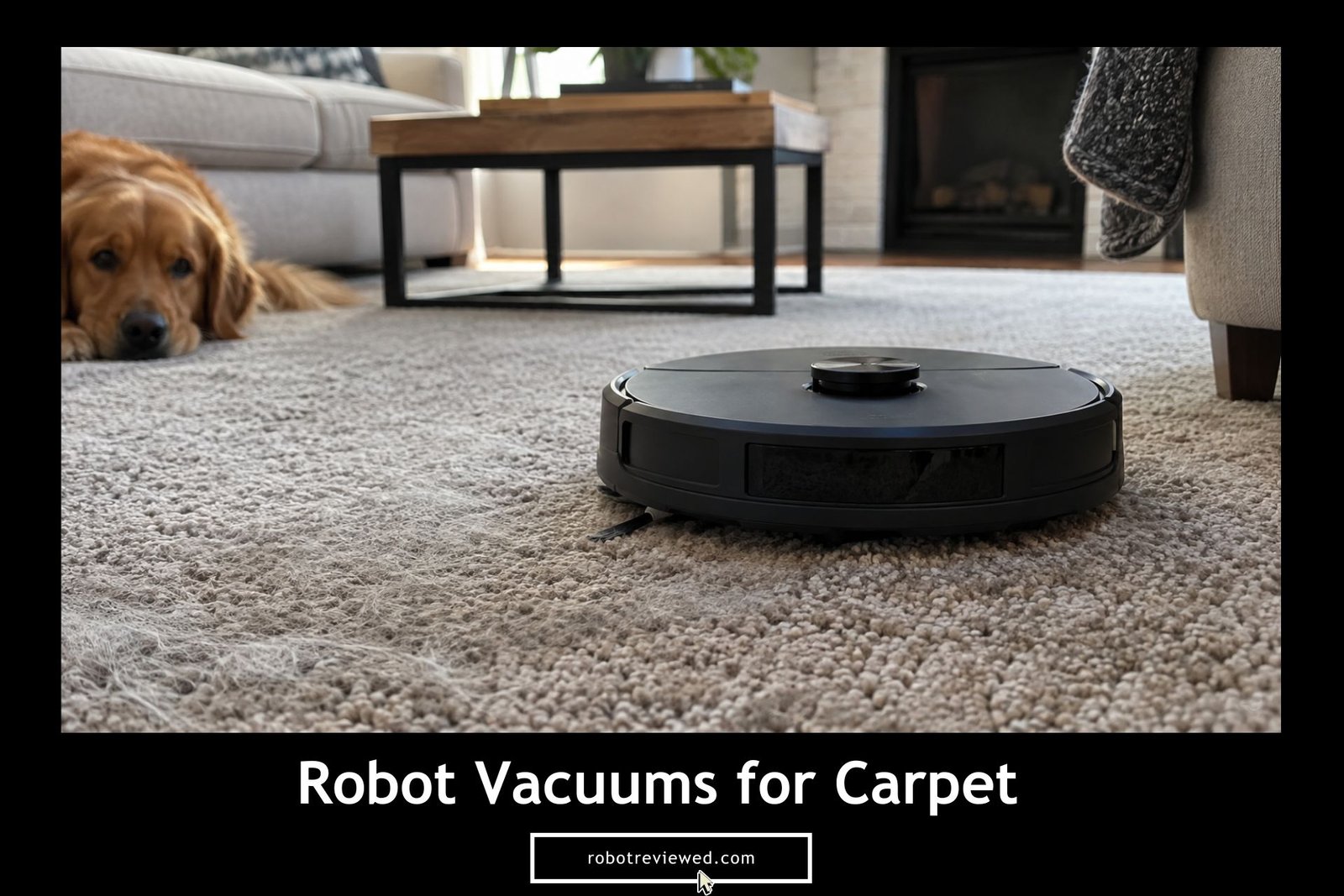
Quick Summary: The best robot vacuums for carpet are Dreame X50 Ultra, Shark AI Ultra, and Roborock Saros models for low-pile, thick carpet, pet hair, and budget cleaning.
Affiliate Disclosure: This page contains Amazon affiliate links. RobotReviewed.com may earn a small commission if you buy through these links, at no extra cost to you. Our reviews and rankings are based on our own testing and research, not on affiliate payments.
I’ve tested more robot vacuums on carpet than I probably should admit, and yes, I can tell you straight up, most of them fail the second they leave hard flooring. Carpet is unforgiving. It hides pet hair, traps dust deep in the fibers, and eats battery life way faster than any spec sheet admits.
You see, finding the best robot vacuums for carpet is not as simple as choosing the model with the highest suction number. So, I compared popular models based on carpet cleaning ability, suction power, brush design, navigation, pet hair pickup, and real buyer feedback. Plus, I even looked at how well each robot handles low-pile, thick, and high-pile carpet.
Here is my list of the best robot vacuum cleaners for carpet…
TABLE OF CONTENTS Quickly jump to a section
- Top 5 Best Robot Vacuums for Carpet Ranked
- Quick Comparison: Best Robotic Vacuums for Carpeted Floors
- My Top 3 Picks (Overall Value for Money Carpet Vacuums)
- Best Robot Vacuum Cleaners for Carpet Reviews
- 1 Overall Best Robot Vacuum for Carpet
- Dreame X50 Ultra
- 2 Best Robot Carpet Cleaner With Self-Emptying Dock
- Shark AI Ultra AV2501S
- 3 Most Powerful Robot Vacuum for Deep or Thick Carpet
- Roborock Saros 20
- 4 Best Budget Robot Vacuum for Carpet
- Roborock Q7 M5
- 5 Top-Rated Robot Vacuum for High-Pile Carpet
- Roborock Saros 10R
- How to Choose a Carpet Cleaning Robot Vacuum
- Low-Pile vs. Medium-Pile vs. High-Pile: Which Carpet Robot Vacuum Do You Need?
- Final Verdict: Which Robotic Vacuum for Carpet Should You Buy?
- FAQs: Carpet cleaning robot vacuums
- How much suction does a robot vacuum need for carpet?
- Are robot vacuums actually good on carpet?
- Can robot vacuums climb onto thick rugs?
- Will a robotic vacuum cleaner damage carpet or rugs?
- Can an robotic vacuum and mop detect carpet automatically?
- Can a robot vacuum replace an upright vacuum for carpet?
Top 5 Best Robot Vacuums for Carpet Ranked
- Overall best robot vacuum for carpet: Dreame X50 Ultra
- Best robot carpet cleaner with self-emptying dock: Shark AI Ultra AV2501S
- Most powerful robot vacuum for deep or thick carpet (high suction power): Roborock Saros 20
- Best budget robot vacuum for carpet (cheapest one): Roborock Q7 M5
- Top-rated robotic vacuum cleaner for high-pile carpet: Roborock Saros 10R
Quick Comparison: Best Robotic Vacuums for Carpeted Floors
| Robot Vacuum | Price | Suction | Main Carpet Brush | Carpet Handling | Mop Protection on Carpet |
|---|---|---|---|---|---|
| Dreame X50 Ultra | $999.99 | 20,000Pa | HyperStream Detangling DuoBrush | Carpet Boost + double-pass cleaning | 10.5mm lift + auto mop removal |
| Shark AI Ultra AV2501S | $549.99 | – | Self-cleaning brushroll | Matrix Clean; multiple passes | No mop system |
| Roborock Saros 20 | $1,599.99 | 36,000Pa | DuoDivide anti-tangle | Dynamic cleaning up to 1.18-in pile | Automatic mop removal |
| Roborock Q7 M5 | $149.99 | 10,000Pa | JawScrapers Comb | Auto Boost on carpet | No mop lift; remove mop manually |
| Roborock Saros 10R | $1,599.99 | 22,000Pa | DuoDivide anti-tangle | AdaptiLift chassis; mid/high-pile support | 17mm lift + auto mop removal |
If you’re just starting your search and want the full picture across every floor type first, check out my guide to the best robotic vacuum cleaners overall before narrowing in here.
My Top 3 Picks (Overall Value for Money Carpet Vacuums)
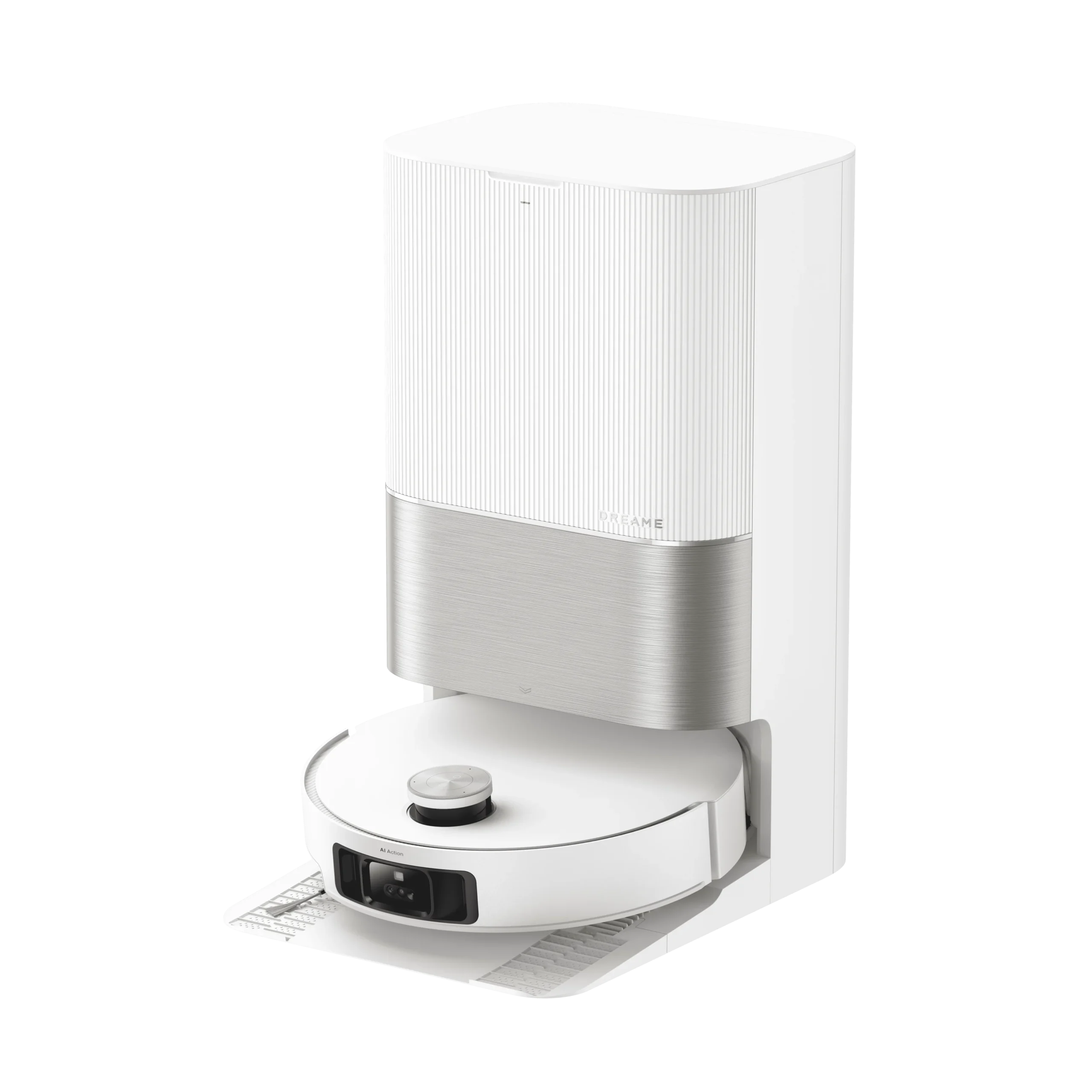
Dreame X50 Ultra
- 20,000Pa suction
- Automatic Carpet Boost
- Double-pass carpet cleaning
- 10.5mm mop lift and auto removal
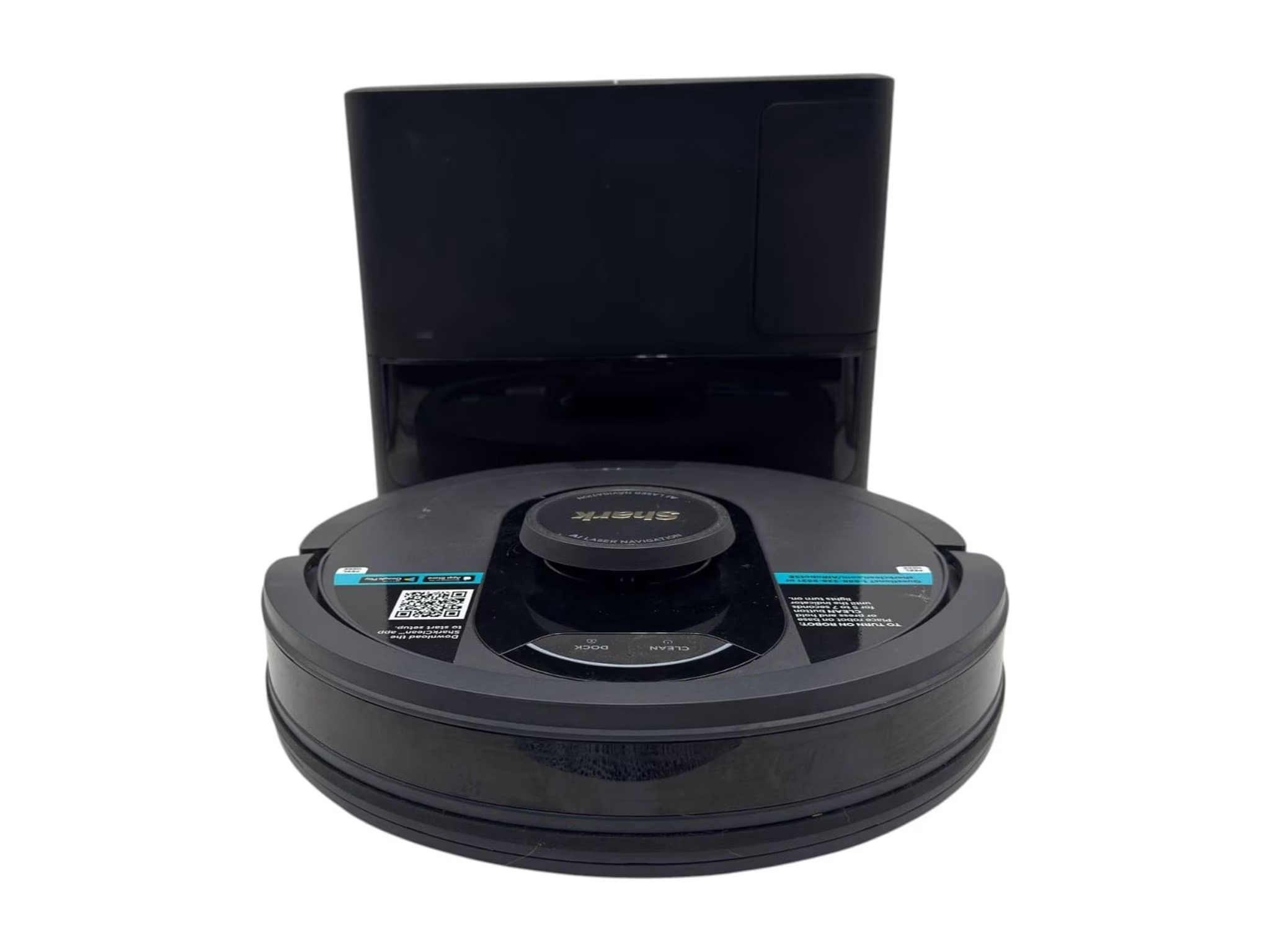
Shark AI Ultra AV2501S
- Matrix Clean multi-pass system
- Bagless 30-day self-empty base
- Self-cleaning brushroll
- True HEPA filtration
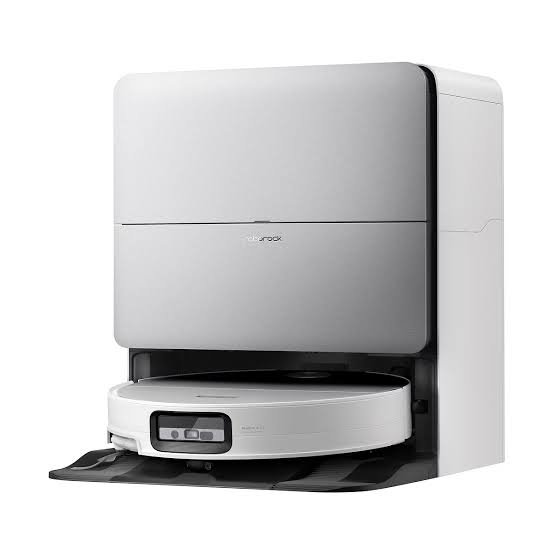
Roborock Saros 20
- 36,000Pa HyperForce suction
- Handles carpet up to 1.18 inches
- DuoDivide anti-tangle brush
- Automatic mop removal
Best Robot Vacuum Cleaners for Carpet Reviews
1 Overall Best Robot Vacuum for Carpet
Smart carpet settings, strong pickup, and safer mopping in one complete cleaner
Dreame X50 Ultra
Positives
Negatives
Positives
Negatives
- 20,000Pa suction pulls fine dirt from carpet fibers
- Carpet Boost raises power as soon as carpet is found
- Intensive mode slows down and cleans carpet twice
- TPU rubber brush handles crumbs, pet hair, and larger bits
- Mops lift or detach to keep different carpets dry
- Premium price is hard to justify for a small home
- The full cleaning dock takes up plenty of floor space
- Its long list of carpet settings takes time to learn
Why Is It Best for Carpet?
The Dreame X50 Ultra is the best robot vacuum for carpet if your home has rugs, fitted carpet, and hard floors together. Its 20,000Pa motor supplies the power, but the carpet controls make the bigger difference. Carpet Boost raises suction when the robot reaches a rug. Intensive Carpet Cleaning mode slows it down and sends it over the same area twice. That second pass gives the brush more time to pull up grit sitting below the top layer.
Dreame also fits a TPU rubber brush made for carpet pickup. It lifts pet hair and larger crumbs without the heavy hair wrap found on many bristle rollers. The mop system is equally useful in a mixed-floor home. It can lift the pads by 10.5mm on short carpet or leave them at the dock before cleaning long-pile carpet. You get strong carpet cleaning without carrying wet mop pads across the rug. That complete mix of suction, repeat passes, brush design, and moisture control puts the X50 Ultra first overall.
Key Specifications
2 Best Robot Carpet Cleaner With Self-Emptying Dock
A bagless HEPA base and repeat-pass cleaning for busy carpeted homes
Shark AI Ultra AV2501S
Positives
Negatives
Positives
Negatives
- Bagless base holds up to 30 days of collected dirt
- True HEPA filtration traps 99.97% of tiny particles
- Matrix Clean makes several passes over each carpet area
- Self-cleaning brushroll cuts down pet-hair wrap
- 360-degree LiDAR maps rooms in light or darkness
- No mop system for bare kitchen or bathroom floors
- The 30-day base holds less than newer 60-day Shark docks
- Shark does not publish a suction rating in pascals
Why Is It Best for Carpet?
The Shark AI Ultra AV2501S makes sense when carpet cleaning and easy dust disposal matter more than mopping. Its Matrix Clean system follows a grid and crosses dirty areas more than once. That pattern is useful on carpet because one quick pass can leave sand, pet dander, and crumbs between the fibers. The self-cleaning brushroll also limits the hair that winds around the roller, so pet homes need less brush cutting.
The base is the main reason to buy this Shark. It pulls dirt from the robot after a run and stores up to 30 days of debris. You do not need replacement dust bags. Its true HEPA system traps 99.97% of dust and allergens down to 0.3 microns inside the base, rather than blowing them back near the carpet. The AV2501S is not the newest all-in-one robot, and it cannot mop. Still, it is a practical robot carpet cleaner for anyone who wants repeat-pass vacuuming, simple upkeep, and a proven bagless self-emptying dock.
Key Specifications
3 Most Powerful Robot Vacuum for Deep or Thick Carpet
Very high suction and a lifting chassis made for deeper carpet pile
Roborock Saros 20
Positives
Negatives
Positives
Negatives
- 36,000Pa motor gives it the highest suction in this list
- Chassis adjusts for carpet pile up to 1.18 inches
- Brush stays in the right position as the body lifts
- DuoDivide roller sends hair toward the open center
- Mops detach before the robot starts carpet cleaning
- The flagship price puts it outside most family budgets
- Full power is louder and uses the battery more quickly
- Thick shag rugs with loose tassels may still need a no-go zone
Why Is It Best for Carpet?
The Roborock Saros 20 is the most powerful robot vacuum for thick carpet in this group. Its 36,000Pa HyperForce motor has far more stated suction than the other four models. High power alone does not promise a deep clean, so Roborock also changed how the robot sits on carpet. AdaptiLift Chassis 3.0 raises or lowers the body to suit carpet pile up to 1.18 inches. A separate brush-stabilizing part keeps the main roller near the fibers while the body moves.
This setup helps the Saros 20 avoid a common thick-carpet problem: a low robot body can press into long fibers and choke the air path. The DuoDivide brush then guides hair and debris toward its open center, where suction can pull them into the bin. Before carpet cleaning, the dock can remove the mop pads, so deep or light-colored carpet stays dry. You are paying a very high price for these parts. Yet for dense carpet, pet hair, and fine grit below the surface, the Saros 20 has the strongest hardware here.
Key Specifications
4 Best Budget Robot Vacuum for Carpet
Strong basic carpet cleaning without paying for a large service dock
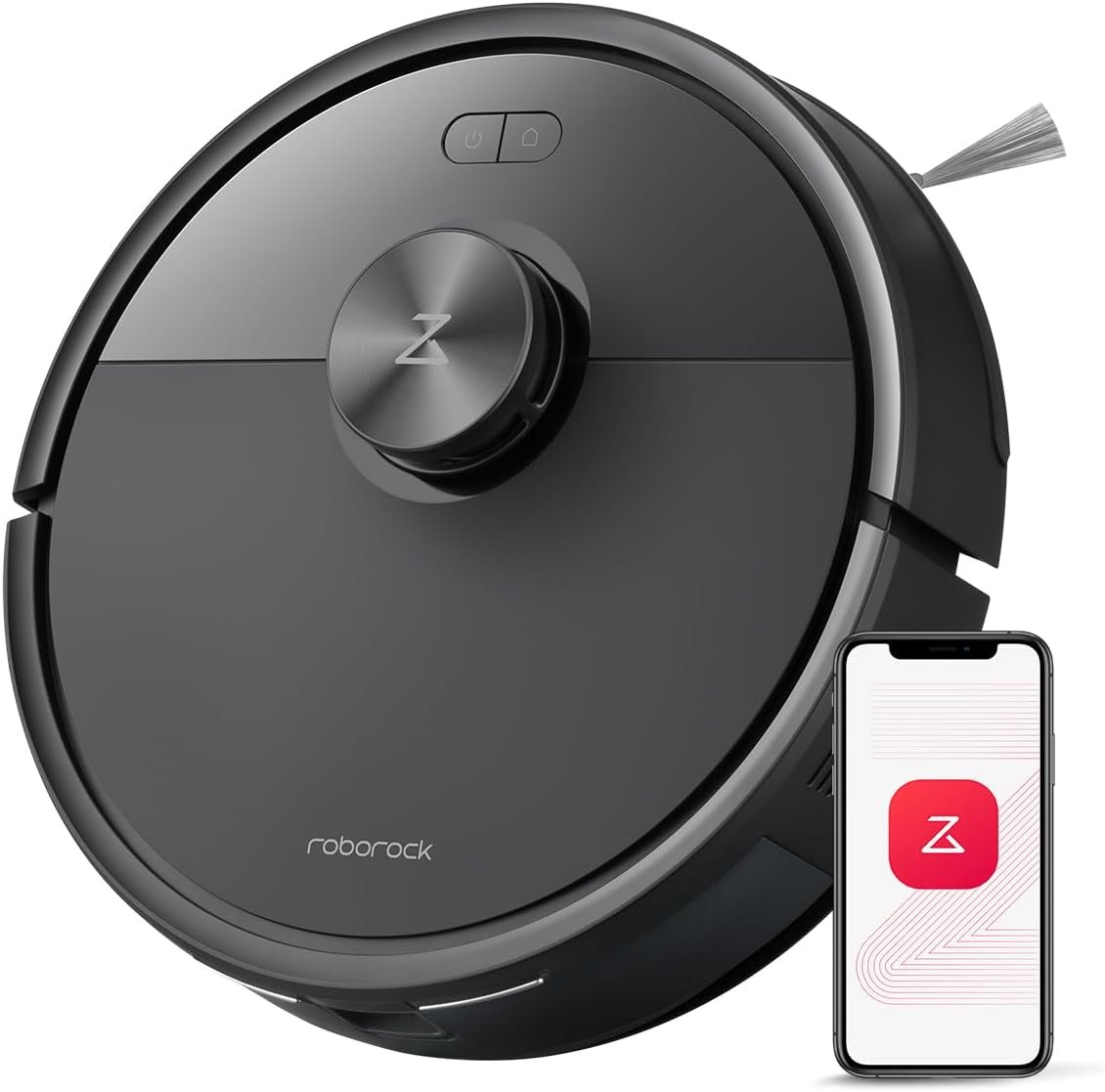
Roborock Q7 M5
Positives
Negatives
Positives
Negatives
- 10,000Pa suction is strong for its low selling price
- Auto Boost adds power when the robot detects carpet
- JawScrapers main brush resists long-hair tangles
- 360-degree LiDAR builds neat rooms and cleaning routes
- Compact charging dock fits into a small space
- This Q7 M5 does not include a self-emptying dock
- The mop pad cannot lift when carpet is detected
- No front structured-light sensor for small-object avoidance
Why Is It Best for Carpet?
The Roborock Q7 M5 is the best cheap robot vacuum for carpet because the lower price does not cut the two features that matter most. You still get 10,000Pa HyperForce suction and automatic carpet boost. When the robot reaches carpet, it raises suction instead of using the same weak setting across every floor. Its JawScrapers Comb main brush and anti-tangle side brush also deal well with daily hair. Roborock says this brush system reached a 95% hair pickup rate in its own testing.
Navigation is better than the price suggests. The Q7 M5 uses 360-degree LiDAR to draw rooms, follow straight paths, and save maps for more than one floor. There are clear trade-offs. This standard M5 returns to a small charging dock, so you must empty its bin yourself. Its mop does not lift over carpet either. Remove the mop holder before a carpet run or mark carpet as a no-mop area. If you mainly want regular vacuuming on low- or medium-pile carpet, those limits are fair for the money.
Key Specifications
5 Top-Rated Robot Vacuum for High-Pile Carpet
A lifting body, dry-carpet controls, and reliable hair handling for plush floors
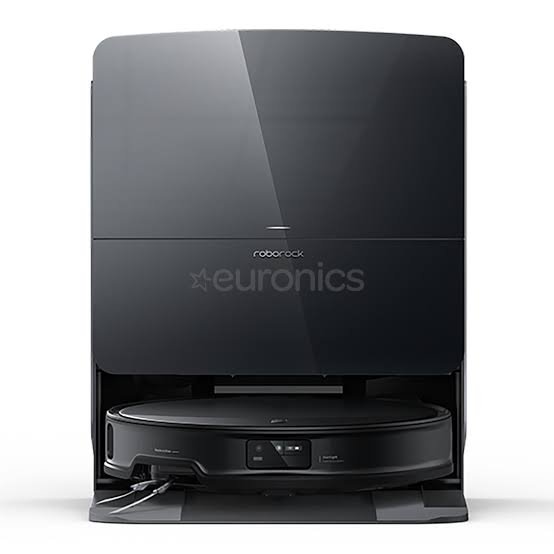
Roborock Saros 10R
Positives
Negatives
Positives
Negatives
- 22,000Pa suction gives it strong pickup on carpet
- AdaptiLift raises the chassis by up to 10mm
- Dock can remove mop pads before a carpet-only run
- DuoDivide brush moves long hair toward the suction opening
- Only 3.14 inches tall for cleaning under low furniture
- It costs far more than a basic carpet-only robot
- Saros 20 now offers higher suction and thicker-pile support
- Loose fringe and very soft shag still need careful mapping
Why Is It Best for Carpet?
The Roborock Saros 10R is a strong high-pile carpet cleaner because it can change its height instead of forcing one fixed body position over every rug. Its AdaptiLift chassis rises by up to 10mm. This gives longer carpet fibers more room below the robot and helps stop the suction opening from pressing flat against a plush surface. The current Amazon US model lists 22,000Pa suction, while the split DuoDivide roller guides hair toward the middle rather than winding it around one long brush.
Carpet stays dry as well. The mops can rise by 17mm, but the safer high-pile option is automatic mop removal. The robot leaves both pads in the dock, vacuums the carpet, and collects them again when hard-floor mopping starts. StarSight mapping and the 3.14-inch body also help it cover areas below beds and sofas where carpet dust builds up. The newer Saros 20 is stronger on paper, yet the 10R remains a well-rounded choice if you want high-pile handling, excellent navigation, and less hair wrapped around the brush.
Key Specifications
How to Choose a Carpet Cleaning Robot Vacuum
Here’s the thing nobody tells you before you buy: most robot vacuums are built with hard floors in mind. Carpet is the afterthought. That’s why so many people drop $400 on a shiny disc, watch it glide beautifully across their kitchen tile, and then get annoyed when it does almost nothing to the living room rug.
Carpet is just harder. Fibers grab dirt and hold onto it. Pet hair weaves itself into the pile. The wheels have to work harder, the brush has to dig deeper, and the battery drains way faster. So if carpet is the main thing in your home, you need to shop differently than someone with an open-plan tile apartment.
This guide walks through what actually matters: suction, brush design, traction, battery, pile height, and what’s just marketing noise. I’ll be honest about the trade-offs too, because there are a few.
Carpet Cleaning Performance
Carpet cleaning performance isn’t one spec. It’s a combination of four things working together:
- Suction power (measured in Pascals, or Pa): pulls debris up and out of the fibers
- Brush roll design: agitates the pile so trapped dirt lets go in the first place
- Downward pressure: how firmly the brush actually presses into the carpet
- Airflow sealing: whether the suction reaches the floor or leaks out the sides
Bristle vs. rubber brush rolls:
| Brush type | Best for | Downside |
|---|---|---|
| Bristle brush | Deep agitation on medium and high-pile carpet | Tangles badly with long hair |
| Rubber (silicone) roller | Pet hair, easy maintenance, low-pile | Slightly less deep agitation on thick pile |
| Dual brush (hybrid) | Best of both — most premium carpet robots use this now | Costs more, more parts to clean |
If you have carpet and pets, the dual-brush anti-tangle system is genuinely worth paying extra for. Actually, most robot carpet vacuum brands like Roborock, Dreame, and Eufy all offer versions of it, usually with a comb or cutting blade built into the brush housing that slices hair as it winds.
The carpet boost feature
The best robot vacuum for carpet should have automatic carpet detection with suction boost. The robot senses it’s rolled onto carpet and ramps suction to max automatically. Two ways this gets done:
- Ultrasonic sensors: bounce sound off the floor surface, more accurate
- Pressure/current sensors: detect the motor working harder, cheaper but slower to react
Here, ultrasonic is better. It reacts faster, and it’s also what lets the robot lift the mop pads before it climbs onto the rug, which matters a lot if you’re buying a combo unit.
Pet Hair Pickup From Carpet
Okay, if you own a Golden Retriever, a Husky, or honestly any cat, this section is probably why you’re here. You see, pet hair on carpet is a totally different problem from pet hair on tile. (also read: best robot vacuum for pet hair)
Generally, on hard floors, hair just sits there, and a light pass picks it up. On carpet, hair weaves into the pile and creates a mat that suction alone can’t break. You need physical agitation.
What actually works for pet hair on carpet:
- Rubber or dual brush rolls: hair slides off instead of wrapping into a tight coil
- Tangle-cutting combs built into the brush housing
- Side brush anti-tangle design: those little spinning arms are hair magnets otherwise
- Sealed HEPA filtration: because vacuuming kicks dander into the air if the filter leaks
- Self-emptying dock: pet hair fills a small onboard bin insanely fast
Now, that last one is not a luxury if you have shedding pets. A robot’s dustbin holds maybe 300-500ml. So, during shedding season, you’ll be emptying it daily, sometimes twice. An auto-empty station with a 2.5L to 3L bag buys you weeks between touches. You can also read my guide on the best self-emptying robot vacuums.
Real talk: no robot vacuum will strip embedded hair out of a thick carpet the way a Dyson or a Shark upright vacuum cleaner will. What a good one does is stay on top of the daily accumulation so your deep cleans are less horrifying. That’s the correct expectation.
Suction Power and Airflow
Suction is measured in Pascals (Pa), and manufacturers love inflating this figure because it’s the easiest spec to market.
Now, how much suction do you actually need for carpet cleaning?
| Suction rating | What it handles | Verdict for carpet |
|---|---|---|
| Under 2,500 Pa | Dust, crumbs on hard floor | Not enough for carpet |
| 2,500 – 4,000 Pa | Light debris, low-pile carpet | Minimum acceptable |
| 4,000 – 8,000 Pa | Most household carpet, pet hair | Solid mid-range sweet spot |
| 8,000 – 15,000 Pa | Medium pile, heavy pet households | Strong performer |
| 15,000 – 30,000 Pa | High-pile, deep embedded dirt | Flagship territory |
Today, flagship models are pushing 20,000 Pa and beyond, which is genuinely impressive on paper. But, and this is important, there are diminishing returns above roughly 10,000 Pa. The jump from 2,000 to 8,000 Pa is night and day. The jump from 15,000 to 22,000 Pa is something you’d struggle to notice on a normal bedroom carpet.
Why airflow matters more than the Pa number
Pascals measure static pressure, basically the strength of the vacuum seal with nothing moving. Airflow (CFM) measures how much air actually moves through the system. You need both. A robot with high Pa but a poorly sealed brush chamber loses that pressure the moment it hits an uneven carpet surface.
Practical things that affect real-world suction:
- Filter condition: a clogged HEPA filter can cut effective suction by 30% or more
- Full dustbin: performance drops noticeably past the halfway mark
- Hair wrapped around the brush: kills agitation and blocks the intake
- Brush height clearance: too high above the carpet and the seal breaks
Carpet Climbing and Wheel Traction
Well, this is the failure point most reviews skip over, and it’s the one that causes the most day-to-day frustration. A best robot vacuum cleaner for carpet has to physically climb onto your rug or carpeted room. So, if it can’t, it either bumps the edge forever, pushes the rug into a wrinkled heap in the corner, or beaches itself halfway and cries for help at 2am.
What to look for:
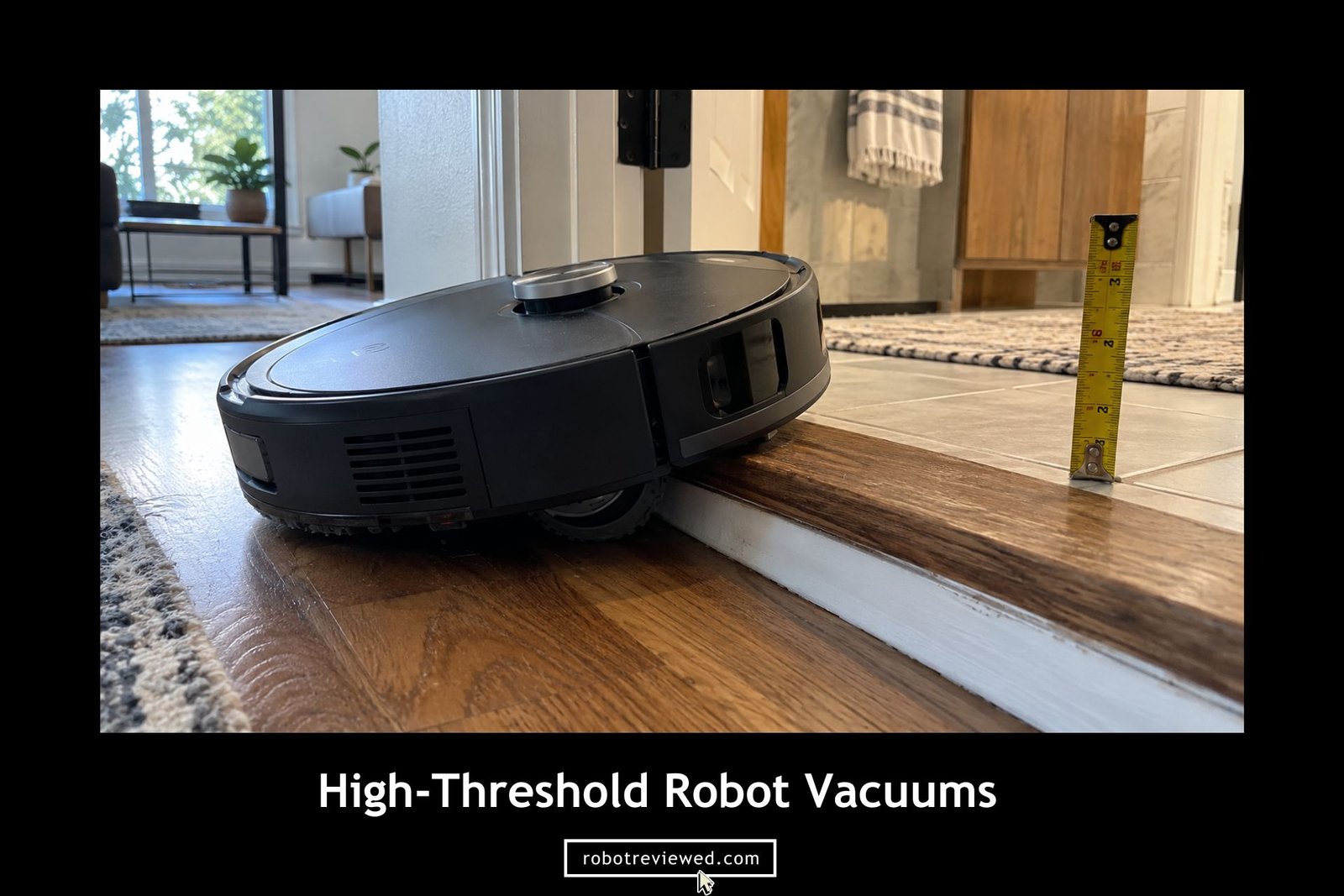
- Threshold climbing height: the spec you want. Basic models handle 1.5cm to 2cm. Better ones do 2cm to 3cm. Premium models with retractable lifting legs or dual-lift chassis now clear 4cm to 6cm obstacles.
- Wheel size and tread: larger, deeply treaded rubber wheels grip carpet far better than small plastic ones
- Suspension travel: spring-loaded wheels keep contact pressure consistent over uneven pile
- Weight distribution: heavier robots (around 4kg+) tend to grip better and push rugs around less
Battery Life on Carpet
Battery runtime on the box is measured on hard floor, in eco mode, with no boost. Now, on carpet, everything changes. Carpet drains battery roughly 30% to 50% faster than hard flooring. The motor works harder, the brush faces more resistance, and carpet boost is constantly kicking in.
| Advertised runtime | Realistic carpet runtime (max power) |
|---|---|
| 120 minutes | ~45–60 minutes |
| 180 minutes | ~70–90 minutes |
| 240+ minutes | ~100–140 minutes |
You must look for a battery of at least 5,200 mAh if you have a mostly carpeted home over 1,500 sq ft. Below 3,200 mAh, you’re going to be dealing with a lot of mid-clean recharging.
Low-Pile vs. Medium-Pile vs. High-Pile: Which Carpet Robot Vacuum Do You Need?
| Carpet type | Pile height | What you need | Realistic expectation |
|---|---|---|---|
| Low-pile (Berber, commercial loop, flatweave) | Under 6mm | 2,500+ Pa, any brush type, standard wheels | Excellent — most robots do great here |
| Medium-pile (typical bedroom plush, cut pile) | 6mm – 13mm | 5,000+ Pa, dual or bristle brush, carpet boost, good traction | Very good with the right model |
| High-pile (shag, frieze, thick area rugs) | 13mm+ | 8,000+ Pa, strong climbing, large treaded wheels, high brush clearance | Mixed — surface cleaning only; deep clean still needs an upright |
Now, shag carpet is where carpet robot vacuum cleaners go to die. The brush roll sinks in, the wheels lose traction, the robot gets stuck, and the mop pads (if it’s a combo unit) get soaked and dragged through the fibers.
So, if you have a shag rug in one room, the smart play is: set up a “no-go zone” in the app for that rug, let the robot handle everything else, and vacuum the shag yourself with an upright. It’s the only way.
Final Verdict: Which Robotic Vacuum for Carpet Should You Buy?
- If your home is mostly low-pile carpet and hard floors: Go mid-range. You can choose carpet robot vacuums with 5,000-8,000 Pa, LiDAR navigation, a rubber brush, and carpet auto-boost. You don’t need a flagship, and you’ll be genuinely happy.
- If you have pets and medium-pile carpet: Now, this is where the money matters. You need to prioritize a dual anti-tangle brush, 8,000+ Pa, a self-empty dock, and sealed HEPA filtration. Hence, expect to spend in the upper-mid to premium range.
- If you have thick or high-pile carpet throughout: Buy for climbing ability and wheel traction first, suction second. Even you can also look for retractable legs or a lifting chassis, large treaded wheels, and a big battery.
- If you have allergies: Sealed HEPA system, frequent scheduled runs, and an auto-empty dock with a sealed bag so emptying doesn’t release everything back into the air.
- If you’re on a tight budget: A cheap carpet robot vacuum cleaner on low-pile carpet is still useful. A cheap robot vacuum on high-pile carpet is money set on fire. Be realistic about your flooring before you buy.
The exact 5 product names I recommend you use
- Overall best robot vacuum for carpet — Dreame X50 Ultra
- Best robot carpet cleaner with self-emptying dock — Shark AI Ultra AV2501S
- Most powerful robot vacuum for thick carpet — Roborock Saros 20
- Best budget robot vacuum for carpet — Roborock Q7 M5
- Top-rated robotic vacuum cleaner for high-pile carpet — Roborock Saros 10R
Read: most reliable vacuum cleaners
FAQs: Carpet cleaning robot vacuums
How much suction does a robot vacuum need for carpet?
2,500 Pa suction power is the realistic minimum for low-pile carpet, but for medium-pile and pet households, aim for 5,000 to 8,000 Pa. Now, high-pile carpet really wants 8,000 Pa or more suction power. Above roughly 10,000-15,000 Pa, you hit diminishing returns; brush agitation and airflow sealing matter more than chasing bigger Pascal numbers at that point.
Are robot vacuums actually good on carpet?
On low- and medium-pile carpet, yes – genuinely good, especially for routine maintenance. But on high-pile and shag, they’re limited or may not be good. The bigger truth is that consistency beats power. The best robot vacuum cleaner running every single day on medium suction keeps carpet cleaner over a month than an upright used once a fortnight.
Can robot vacuums climb onto thick rugs?
Yes, most of the best carpet cleaning robot vacuums can handle 1.5cm to 2cm thresholds without trouble. Premium models with lifting-leg or dual-lift chassis systems now clear 4cm to 6cm. But for thick rugs, you need to check the climbing height spec specifically and make sure the rug edge is bound or tapered.
Will a robotic vacuum cleaner damage carpet or rugs?
Generally no. Normal cut-pile and plush carpet is completely fine. Two exceptions worth knowing: loop-pile Berber can snag on aggressive bristle brushes, so use a rubber roller and lower suction there. And delicate, antique, or hand-knotted rugs – just set a no-go zone.
Can an robotic vacuum and mop detect carpet automatically?
Yes, most mid-range and premium carpet cleaning robot vacuum models do. Ultrasonic carpet sensors are the more accurate method: the robot detects carpet, boosts suction, and lifts or retracts the mop pads before crossing.
But again, budget robot vacuums for carpet use motor-current detection, which works but reacts more slowly, so you occasionally get a wet streak at the rug edge. Also, if you’re buying a 2-in-1 vacuum-mop for a carpeted home, a mop-lifting height of 7mm or more (or fully detachable pads) should be on your must-have list.
Can a robot vacuum replace an upright vacuum for carpet?
Honestly, not entirely. A robot vacuum cleaner handles 80-90% of routine carpet maintenance: daily dust, crumbs, surface pet hair, and it does it without you lifting a finger, which is the whole point.
But for deep-embedded dirt, post-renovation dust, stair carpet, and thick-pile deep cleaning, you still want an upright vacuum cleaner with a proper beater bar and much higher airflow.
Most people who own both end up using the upright once or twice a month instead of weekly, and that’s a pretty good deal.