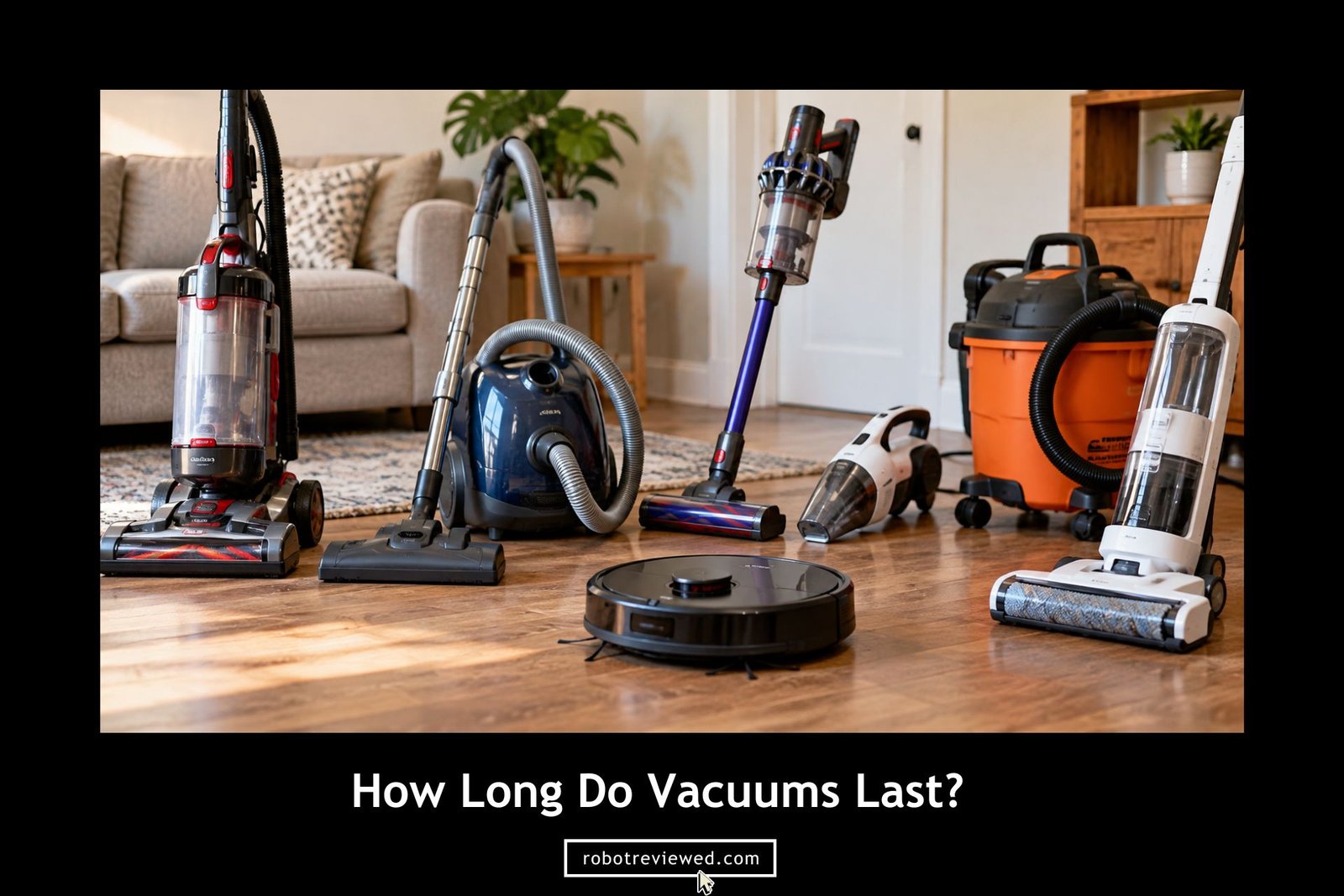
So how long should you expect your vacuum to last? I would say: Plan on 8 to 10 years from a corded upright or canister, and closer to 3 to 6 years from anything with a battery. But also, you must empty it often, clean the filters, and keep the brush roll free of hair, and you give yourself a fair shot at the top of each range.
Okay, this guide gives you a straight answer to the question: how long do vacuum cleaners last? You will see the average vacuum cleaner lifespan for each type, the habits that shorten or stretch it, and the signs that say it’s time to replace yours.
TABLE OF CONTENTS Quickly jump to a section
Average Vacuum Cleaner Lifespan by Type
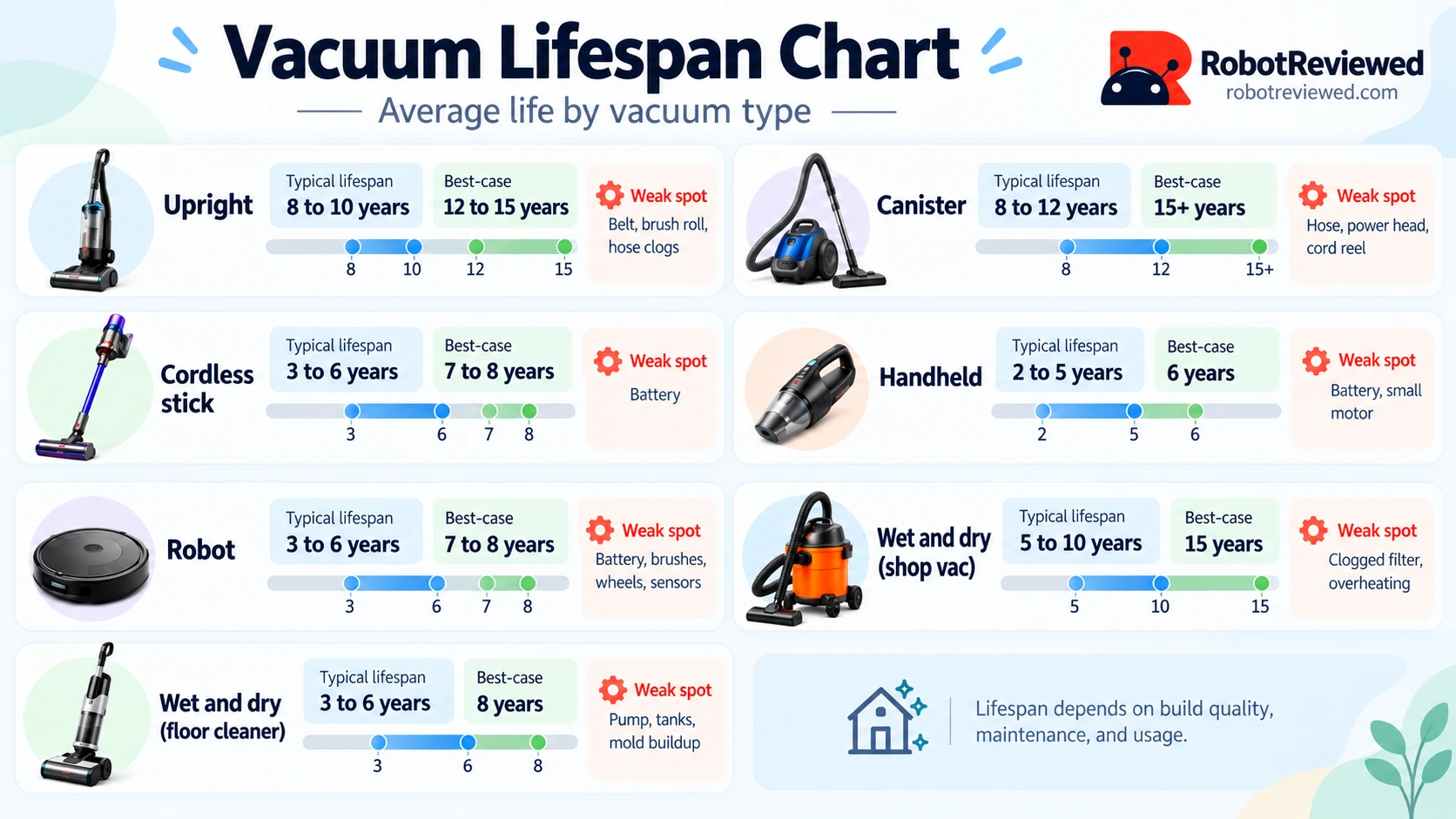
Corded uprights and canisters usually last 8 to 10 years (sometimes 12 to 15 with good care), while battery-powered stick, handheld, and robot vacuums typically last only 3 to 6 years.
| Vacuum type | Typical lifespan | Best-case lifespan | Most common weak spot |
|---|---|---|---|
| Upright | 8 to 10 years | 12 to 15 years | Belt, brush roll, hose clogs |
| Canister | 8 to 12 years | 15+ years | Hose, power head, cord reel |
| Cordless stick | 3 to 6 years | 7 to 8 years | Battery |
| Handheld | 2 to 5 years | 6 years | Battery, small motor |
| Robot | 3 to 6 years | 7 to 8 years | Battery, brushes, wheels, sensors |
| Wet and dry (shop vac) | 5 to 10 years | 15 years | Clogged filter, overheating |
| Wet and dry (floor cleaner) | 3 to 6 years | 8 years | Pump, tanks, mold buildup |
Okay, notice the pattern in this table: vacuum cleaners that run on batteries (cordless vacuums) usually wear out sooner than machines you plug into a wall. The battery is the part that ages fastest, and it is often the reason a perfectly good vacuum ends up in the trash. Corded vacuum cleaners also tend to have larger motors, and those motors stay strong through many more hours of cleaning.
Plus, price plays a role too, since a budget vacuum cleaner model and a premium model of the same type can differ by several years. You need to keep in mind that these numbers describe normal home use, not daily commercial cleaning, which wears a machine out much faster.
How Long Do Different Types of Vacuums Last?
Upright Vacuums Life Expectancy
Upright vacuum lifespan: 8 to 10 years, though well-built models from good brands can reach 12 to 15 years.
Upright vacuums are the classic choice for carpeted homes, and they are built to handle a lot of work. The motor is large, the parts are easy to reach, and even most of the wear items can be replaced without special tools.
The usual trouble spots are the drive belt, the brush roll, and the hose. You see, hair wraps around the brush roll until it can barely spin, and that strain can burn out the belt or damage the bearings. You can expect to change the belt every 6 to 12 months, depending on how often you clean. It costs very little and takes about five minutes, so skipping it is a false saving.
Plastic parts can also crack over time, especially if you drag the vacuum by the hose or bump it down the stairs. An upright vacuum makes the most sense if you have wall-to-wall carpet or a large floor area, because the wide cleaning head covers ground quickly.
Canister Vacuums Life Expectancy
Canister vacuum lifespan: 8 to 12 years, with some quality models running 15 years or longer.
Canisters are often the longest-lasting vacuums you can buy for a home. The motor sits in a separate body on the floor, so it is not shaken around, and it usually has more room to stay cool. Plus, the hose, wand, and power head are also separate parts, so you can replace one piece instead of the whole machine. That single feature adds years to the life of many canisters.
Generally, the weak spots are the hose, which can split near the handle, and the retractable cord reel. Motorized power heads can also fail, but they are usually repairable. Canister vacuums mainly suit you well if you have stairs, hard floors, or a mix of surfaces, and you do not mind pulling a body along behind you.
Cordless Stick Vacuums Life Expectancy
Average cordless stick vacuum lifespan: 3 to 6 years, and the battery is usually the deciding factor.
Cordless sticks are popular because they are light and quick to grab, but they carry a built-in expiry date. You know, lithium-ion batteries lose capacity with every charge cycle, and most are rated for a few hundred cycles before the drop becomes obvious.
In practice, cordless vacuum battery life often falls between 2 and 5 years. You will notice it when a run time that once covered the whole house shrinks to a single room. So, before you buy, you must check whether the brand sells replacement batteries and whether you can swap them yourself. Obviously, a removable battery can turn a 4-year vacuum into a 7-year one.
You can also stretch battery life with a few small habits that cost you nothing. First, use the low or auto mode for everyday floors, keep the machine out of hot garages, and also avoid running it completely flat every time.
Max power mode in cordless vacuums drains the battery fast and creates extra heat, so save it for stubborn spots only. Cordless sticks work best as a second vacuum for quick cleanups, or as a main vacuum in a small apartment.
Handheld Vacuums Life Expectancy
Typical handheld vacuum lifespan: 2 to 5 years, and many cheap ones fall on the short end.
Handheld vacuums have the smallest motors and the smallest batteries, so they wear out the quickest. People also tend to buy them cheaply and use them roughly, which does not help. Their tiny dust cups fill up quickly, and a clogged filter makes the motor work harder and run hotter. You must clean the filter after every few uses, following your manual, and let a washed one dry fully before you put it back.
Corded handhelds and car vacuums that plug into the lighter socket often outlast battery versions, because they have no battery to fade. Still, you should think of any handheld as a helper tool and not as your main cleaner.
Robot Vacuum Cleaners Life Expectancy
Robot vacuum lifespan: 3 to 6 years, with the battery and moving parts wearing out first.
A robot vacuum cleaner works differently from every other type on this list, because it runs almost every day. If you schedule it for one hour a day, that adds up to about 365 hours of running time each year. You see, a person with an upright might vacuum for an hour or two per week, so the robot piles up hours several times faster. That is a big reason its lifespan looks shorter on paper.
The battery usually lasts 2 to 4 years, and many models let you swap in a new one. Also, side brushes, main brushes, and filters are meant to be replaced far more often, sometimes every few months. Wheels, cliff sensors, and bumpers also collect hair and dust. A quick weekly wipe of the sensors and a trim of tangled hair keeps the robot from getting confused and straining its motors.
One more risk is easy to miss, because many robots depend on a phone app to work properly. So, if a company stops supporting an older model, some features may stop working even though the hardware is still fine.
Wet and Dry Vacuums Life Expectancy
Average wet and dry vacuum lifespan: 5 to 10 years for shop vacs and 3 to 6 years for floor cleaners.
This category covers two very different machines, so it helps to separate them. A shop vac is a simple tank with a motor on top, made for sawdust, garage mess, and water spills. Because shop vacs have few parts and rugged plastic, many can run for a decade or more in a garage or workshop. Actually, common trouble includes a clogged filter, which makes the motor overheat, and water or fine dust reaching the motor.
Wet and dry floor cleaners, the kind that scrub and suck up dirty water in one pass, are more complicated. They have pumps, tanks, hoses, and brush rolls, and each one can clog or fail.
For both kinds, the best habit is to empty and rinse the tank after each job and leave every part open to dry. Damp parts grow mold and start to smell long before anything actually breaks.
What Affects How Long a Vacuum Cleaner Lasts?
Two vacuums of the same model can end up with very different lifespans. The gap usually comes down to a handful of factors, and most of them are in your hands.
- Build quality and brand: A sturdier motor, thicker plastic, and metal parts in the right places all add years. Cheap machines often cut costs in those same spots, which is why they may feel fine for two years and then fall apart. But again, a higher price does not always mean better durability, so read owner reviews from people who have used the model for two or three years.
- How often you use it: Well, every vacuum has a limited number of running hours in it, even if the maker never prints that number. So, if a motor were good for 1,000 hours, one hour a week would last about 19 years, while one hour a day would last under three. That number is only an example, but the logic holds for every machine.
- Maintenance: Maintenance is the biggest factor you control, and it costs far less than a new machine. A vacuum with clean filters, a clear hose, and a hair-free brush roll runs cooler, and a cooler motor lasts longer. Basically, heat is the quiet enemy of every motor and every battery inside a vacuum.
The table below gives you a simple routine that works for most household vacuums. You can follow your own manual where it says something different, because filter types and parts vary between models.
| Task | How often | Why it matters |
|---|---|---|
| Empty the bin or change the bag | When about two-thirds full | Keeps airflow strong and reduces motor strain |
| Clean or rinse the filter | Every 1 to 3 months | Prevents clogs and overheating |
| Remove hair from the brush roll | Every 2 to 4 weeks (weekly with pets) | Protects the belt and bearings |
| Check the hose and wand for blockages | Every few months, or when suction drops | Restores airflow without a repair |
| Replace the drive belt (uprights) | Every 6 to 12 months | Keeps the brush spinning properly |
| Replace the exhaust or HEPA filter | Every 6 to 12 months | Keeps fine dust out of the motor and your air |
| Wipe sensors and check wheels (robots) | Weekly | Prevents navigation errors and motor strain |
- What you vacuum: Fine dust from drywall, cement, fireplace ash, or sanding will clog filters and can wreck a household motor quickly. Use a shop vac with the right filter for renovation dust and keep your home vacuum away from it. Larger items like coins, screws, and pebbles can jam the brush roll or chip parts inside the machine.
- Your home and floors: Thick carpet, pet hair, and a large floor area all make a vacuum work harder. A machine in a small apartment with hard floors may outlive the same model in a big house with three shedding dogs.
- Storage and handling: Wrapping the cord tightly, yanking it from the wall, and dragging the machine by the hose all cause slow damage. Batteries and plastic also suffer in a hot garage or a damp basement, so store your vacuum indoors in a cool, dry spot.
- Parts, repairs, and warranty: A vacuum only lasts as long as you can get parts for it. Brands that sell parts for many years let you keep an old machine running, while brands that drop support push you toward a new purchase. A longer warranty is a decent hint that the maker expects the product to last, though it is not proof.
How Do You Know Your Vacuum Needs Replacing? When to Replace…
- Weak suction power that stays weak even after you empty the bin, wash the filter, and clear the hose usually points to a tired motor or an air leak.
- Treat a burning smell or smoke as a stop sign: You must unplug the vacuum immediately, because it can signal a failing motor, belt, or battery.
- The motor overheats and shuts off again and again, even after you have cleaned the filters, which suggests real wear inside. A single shutoff caused by a clog is normal, since many vacuums have a built-in thermal cutoff.
- Grinding, rattling, or screaming noises can mean a jammed brush roll, which is an easy fix, or worn motor bearings, which are much harder to repair.
- On a cordless model, a battery that runs only a few minutes instead of thirty means the cells are worn, so check if a replacement is sold.
- Dust blowing back out of the exhaust or the seams means the seals and filters can no longer trap fine particles, which matters if you have allergies.
- Cracked housings, broken latches, or missing parts that you cannot buy anymore turn a repair into a guessing game, and that is a good moment to move on.
FAQs: Life Expectancy of Vacuum Cleaners
Is 10 years a long time for a vacuum cleaner?
Yes, for most households 10 years is a long time, and it sits above the typical lifespan of most vacuum types. A well-built upright or canister that reaches this age has done its job and probably outlived a few cheaper machines.
The picture is different for a cordless stick or a robot vacuum. So, if yours is still running well at 10 years, it has probably had at least one new battery along the way, or you are a very careful owner.
Do bagged vacuums last longer than bagless vacuums?
Not automatically, because no rule says a bag adds years, and the brand and build quality matter far more than the dust system.
That said, bags do offer one real advantage for the long-term health of the motor. They trap fine dust inside a closed bag, so less of it reaches the filter and the motor, which can help a machine stay healthier for longer.
Bagless vacuum cleaner models skip the ongoing cost of bags, but they ask more from you in cleaning and upkeep. So, if you forget the filters, a bagless machine can clog and overheat, just like a bagged one with a full bag.
Now the honest answer is that your habits matter more than the design. A bagged canister and a bagless upright from solid brands can both last 10 years if you look after them.
Is it worth repairing an old vacuum cleaner?
Often it is, but it really depends on what is broken and how much the fix costs. Cheap repairs like belts, filters, hoses, and brush rolls are almost always worth doing.
You can do most of these yourself in under 15 minutes with a screwdriver and a how-to video. Also, you must check your warranty before you pay for anything, because some brands cover motors or batteries for several years.
Now, for bigger repairs, use the half-price rule, which says to replace the machine if the quote passes about half the cost of a similar new one. It is a rule of thumb and not a law, so adjust it for a premium machine you already like.