You want a vacuum that cleans well, lasts for years, and does not drive you crazy every week. That sounds easy, but the store shelf tells a different story. There are hundreds of models out there, and every box promises the most power, the longest battery, and the smartest brain.
The truth is that vacuum cleaner preferences change from person to person. A family with two dogs needs something very different from a student in a small apartment. One buyer cares most about price. Another buyer cares most about noise. Honestly, both of them are right.
In this guide, you will see what buyers really like in 2026. You will read about the main vacuum types, floor types, pet hair, allergies, home size, and price. You will also see which features matter and which ones just look good on the box.
TABLE OF CONTENTS Quickly jump to a section
- What Are the Most Common Vacuum Cleaner Preferences in 2026?
- Which Type of Vacuum Cleaner Do People Prefer?
- Vacuum Cleaner Preferences by Floor Type
- Vacuum Cleaner Preferences for Pet Owners
- Corded vs Cordless Vacuum Cleaner Preferences
- Bagged vs Bagless Vacuum Cleaner Preferences
- Robot Vacuum vs Traditional Vacuum: Which Do People Prefer?
- Which Vacuum Cleaner Features Matter Most to Buyers?
- Vacuum Cleaner Preferences for Allergy and Dust Control
- Do People Prefer Vacuum and Mop Combos?
- How Much Are People Willing to Pay for a Vacuum Cleaner?
- Smart Vacuum Cleaner Preferences
- What Makes People Dislike a Vacuum Cleaner?
- How to Choose a Reliable Vacuum Cleaner Based on Your Preferences
- Final Thoughts
- FAQs
What Are the Most Common Vacuum Cleaner Preferences in 2026?
The most common vacuum cleaner preferences in 2026 are easy use, strong pickup on pet hair, low noise, and a price that feels fair. Cordless stick vacuums and robot vacuums lead most shopping lists. Upright and canister models still win with people who want deep cleaning for less money.
Let me break it down a bit. Most buyers want a vacuum that picks up hair without tangles. Many want a machine quiet enough to let them talk on the phone nearby. A lot of people also want less work, and that is why robot vacuums with self-emptying docks sell so well. The dock holds dirt for up to 60 days, so you touch the dust only a few times a year.
- Battery life comes next. A cordless stick vacuum usually runs 30 to 60 minutes on a charge. That time drops to about 8 to 15 minutes on max power. Buyers now check both numbers, not just the big one on the box.
- Filters matter more than before, too. A sealed system with a HEPA filter catches 99.97% of particles at 0.3 microns, so families with allergies ask for it a lot.
- Price plays a big role as well. Most people spend between $150 and $600. Under $150 is popular for small homes and second vacuums. Above $800 is mostly for people who want a robot that empties itself, washes its own mops, and dries them.
Which Type of Vacuum Cleaner Do People Prefer?
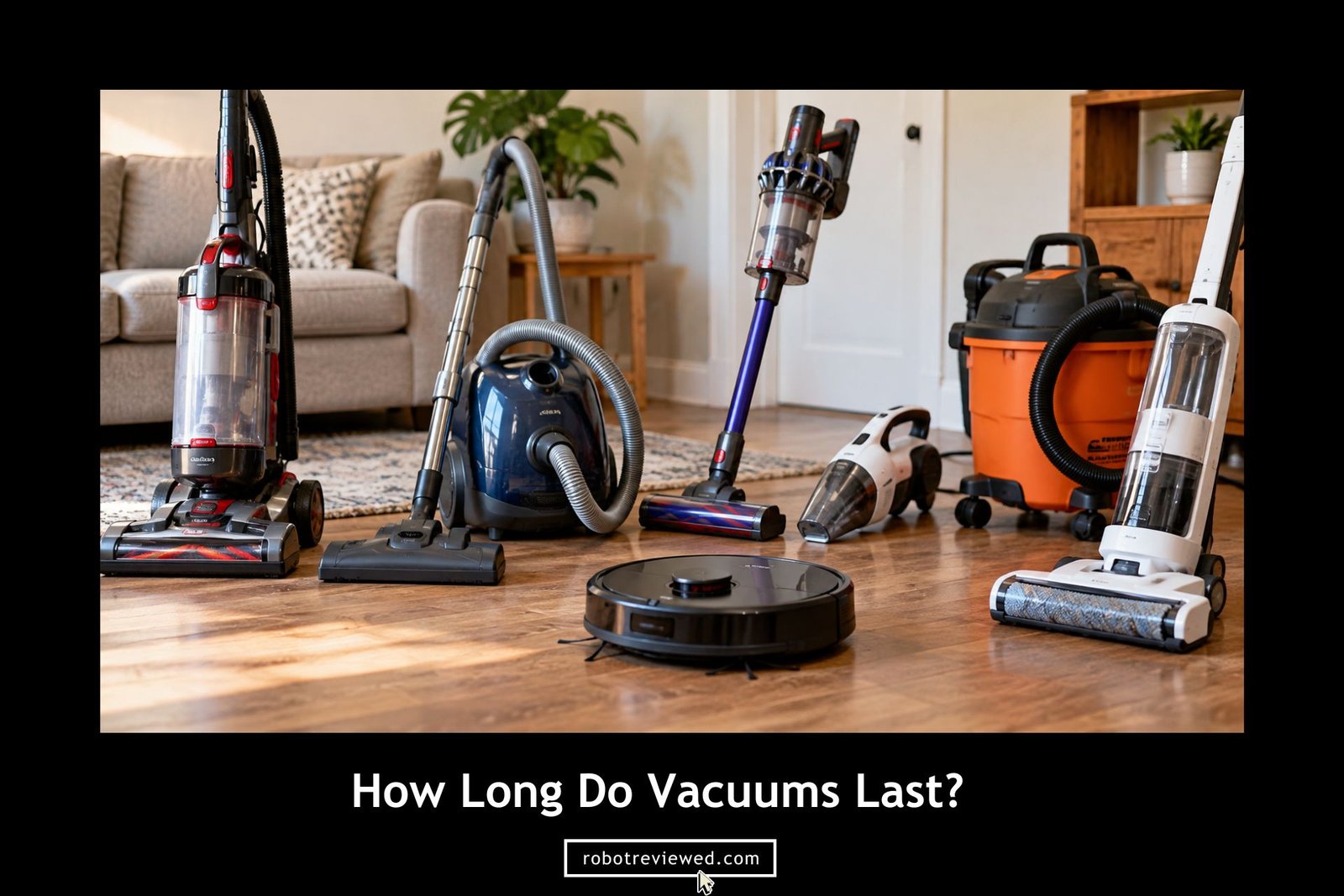
Generally, people prefer cordless stick vacuums for daily cleaning and robot vacuums for hands-free cleaning. Upright and canister vacuums still have loyal fans, mainly for big carpets and deep cleaning.
Well, most homes actually own more than one type. You might run a robot every day, use a stick vacuum for quick spills, and pull out an upright once a week for the rugs.
Robot Vacuum Cleaners
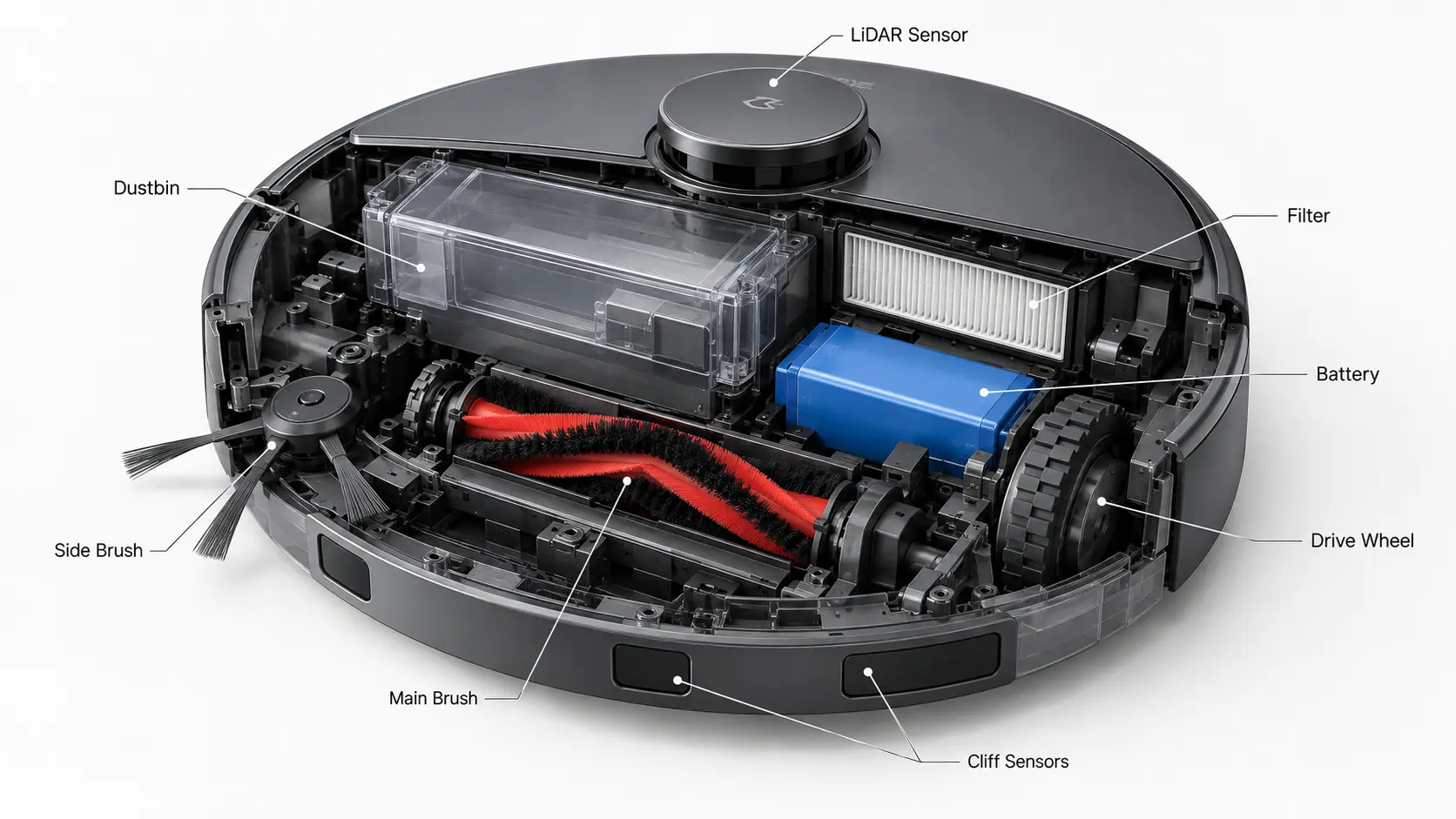
Robot vacuum cleaners are the top pick for people who want clean floors with almost no effort. You need to just press a button in the app, and the robot does the rest. Most models run 90 to 240 minutes per charge and cover about 1,500 to 3,000 square feet before they go back to the dock.
Most budget robot vacuums list about 2,000 to 4,000 Pa suction; some flagship models list 20,000 Pa or more. The big number sounds great, but the brush design and the mapping matter just as much.
But also, robots do have limits. The dustbin is small, usually 0.3 to 0.5 liters, so you need a self-empty dock unless you like emptying it every day. The robot also cannot clean stairs. Honestly, most robot owners still keep a small stick vacuum for the stairs and the corners.
Cordless Stick Vacuums
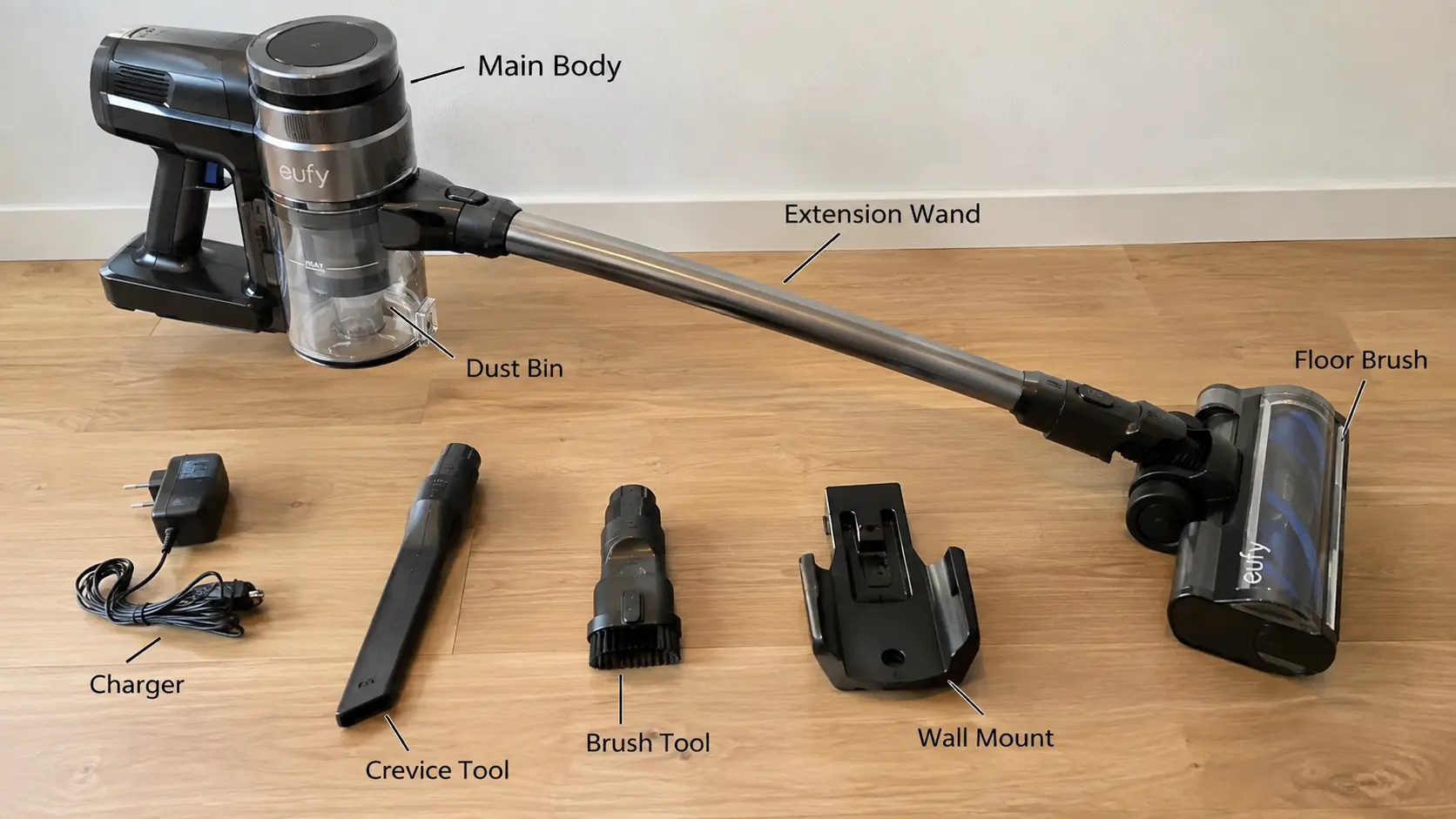
Cordless stick vacuums are actually the most popular pick for quick, everyday cleaning. The vacuum can fit in a closet or on a wall dock, and you can easily grab it in seconds. It weighs about 4 to 8 pounds, so you can carry it up the stairs with one hand.
Runtime is usually 30 to 60 minutes on eco mode. Max mode drains the battery in around 8 to 15 minutes. So a small home is fine, but a big house may need a spare battery. Also, top models can easily reach around 150 to 260 air watts, and that is enough for most carpets.
The dustbin is small, about 0.5 to 0.8 liters, so you need to empty it after each job. Sure, that is a bit annoying, but still, the ease of use is worth it for many owners.
Upright Vacuum Cleaners
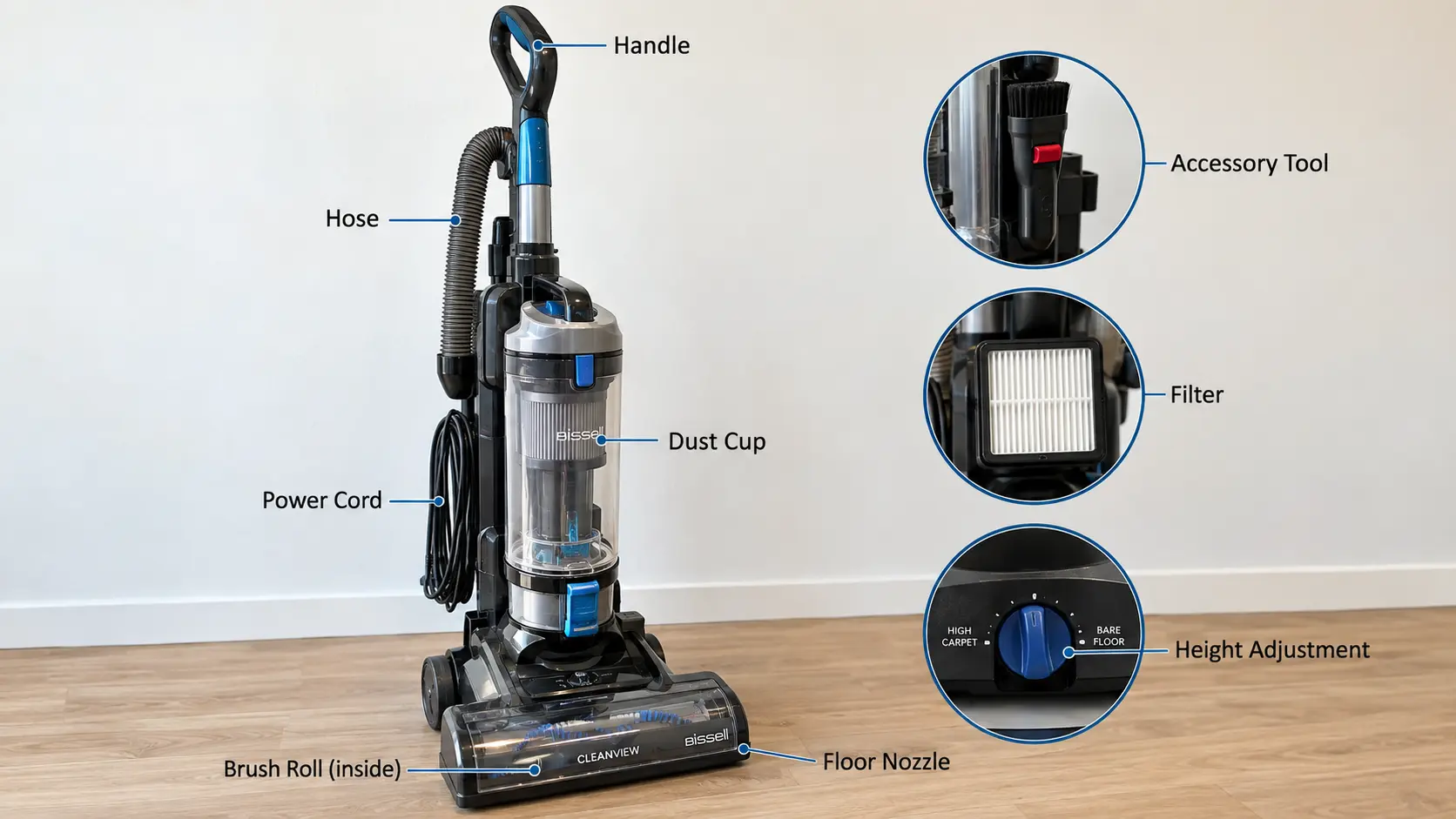
Upright vacuum cleaners are still the best choice for big carpets and deep cleaning on a fair budget. The motor and brush sit in one body, so the machine pushes hard into the carpet and pulls dirt out of the deep fibers. Generally, most corded uprights cost $100 to $400, which is less than a good cordless stick.
The weight is the main problem here. An upright usually weighs 12 to 20 pounds, so stairs feel like a workout. The cord is another issue, as most cords run 25 to 35 feet, so you will switch outlets from room to room.
But again, uprights have big bins, about 1.5 to 2.5 quarts, so you empty them less often. You can actually look for a light or self-propelled model if you have a bad back.
Canister Vacuum Cleaners
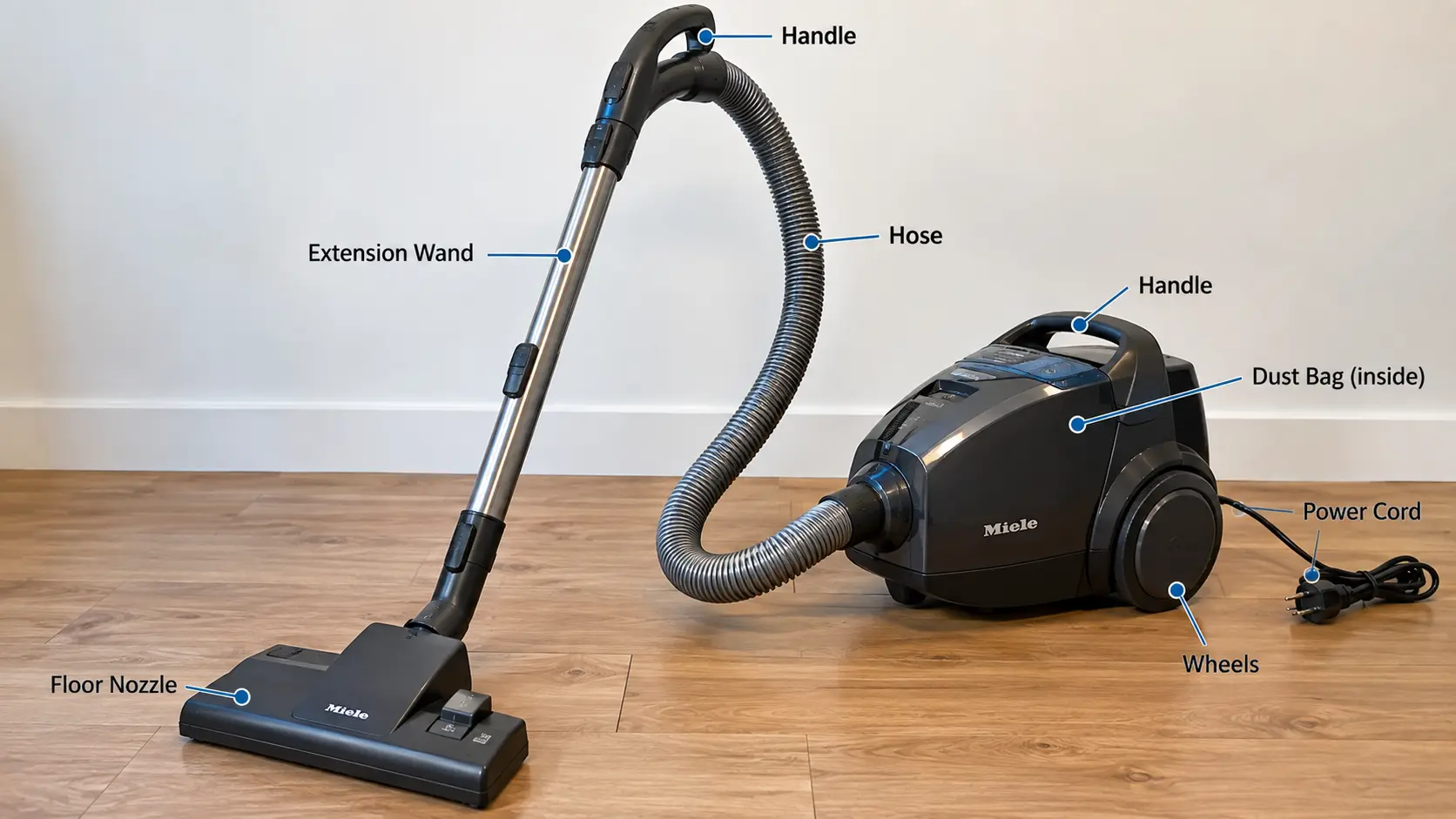
Canister vacuum cleaners are the best pick for homes with lots of hard floors, stairs, and tight spots. The motor sits in a body that rolls behind you, and you only hold a light wand and head. The wand is easy on your arm, and the long hose reaches under couches and up to ceiling corners.
Canisters are pretty quiet, too. Basically, many bagged models run around 60 to 72 decibels, which is close to normal talking. The bag holds 2 to 4 liters, and the sealed system keeps the dust inside. A good canister can last 10 years or more with normal care.
But here, the downside is storage. The body is long and the hose needs winding, so you need more closet space. Anyway, if you have lots of hardwood, a canister is very hard to beat by any type of vacuum cleaner.
Wet and Dry Vacuum Cleaners
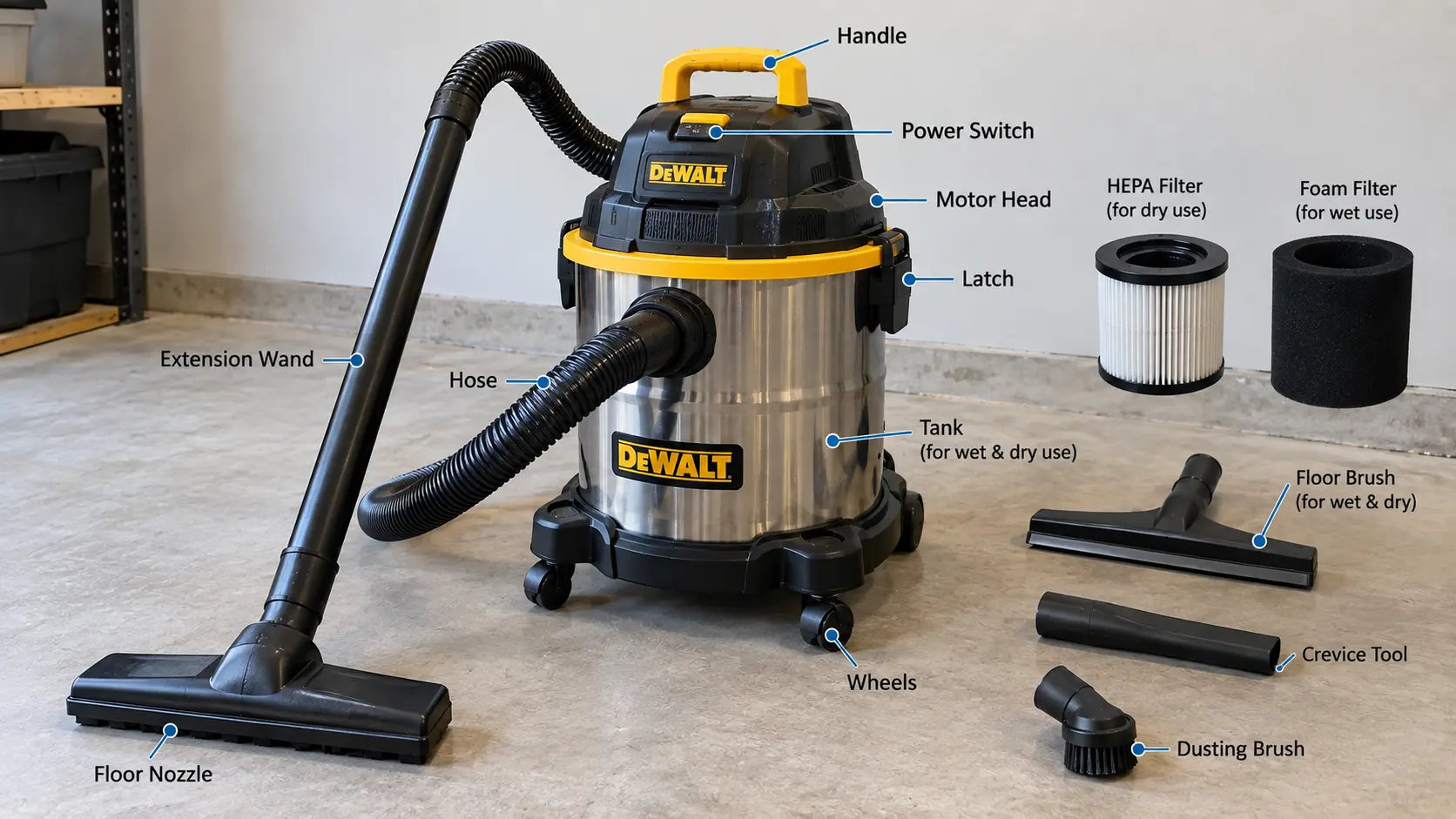
Wet and dry vacuum cleaners are the top pick for people who want one machine to pick up spills and then dry dirt at the same time. The vacuum pulls up crumbs and also wet messes like juice, muddy paw prints, and pet accidents. Also, many of these top home models have two tanks, one for clean water and one for dirty water.
The cleaning power is quite nice as well, but the upkeep is real. You must rinse the tank and the brush roll after each use, or the smell shows up fast. Generally, the best wet and dry vacuum cleaners cost about $200 to $500. Garage shop vacs are different. They can cost $50 to $200 and hold 2.5 to 16 gallons.
Look, a wet and dry vacuum is not the main vacuum for most people. It mainly works best as a second machine for messy jobs, like your kitchen.
Handheld Vacuum Cleaners
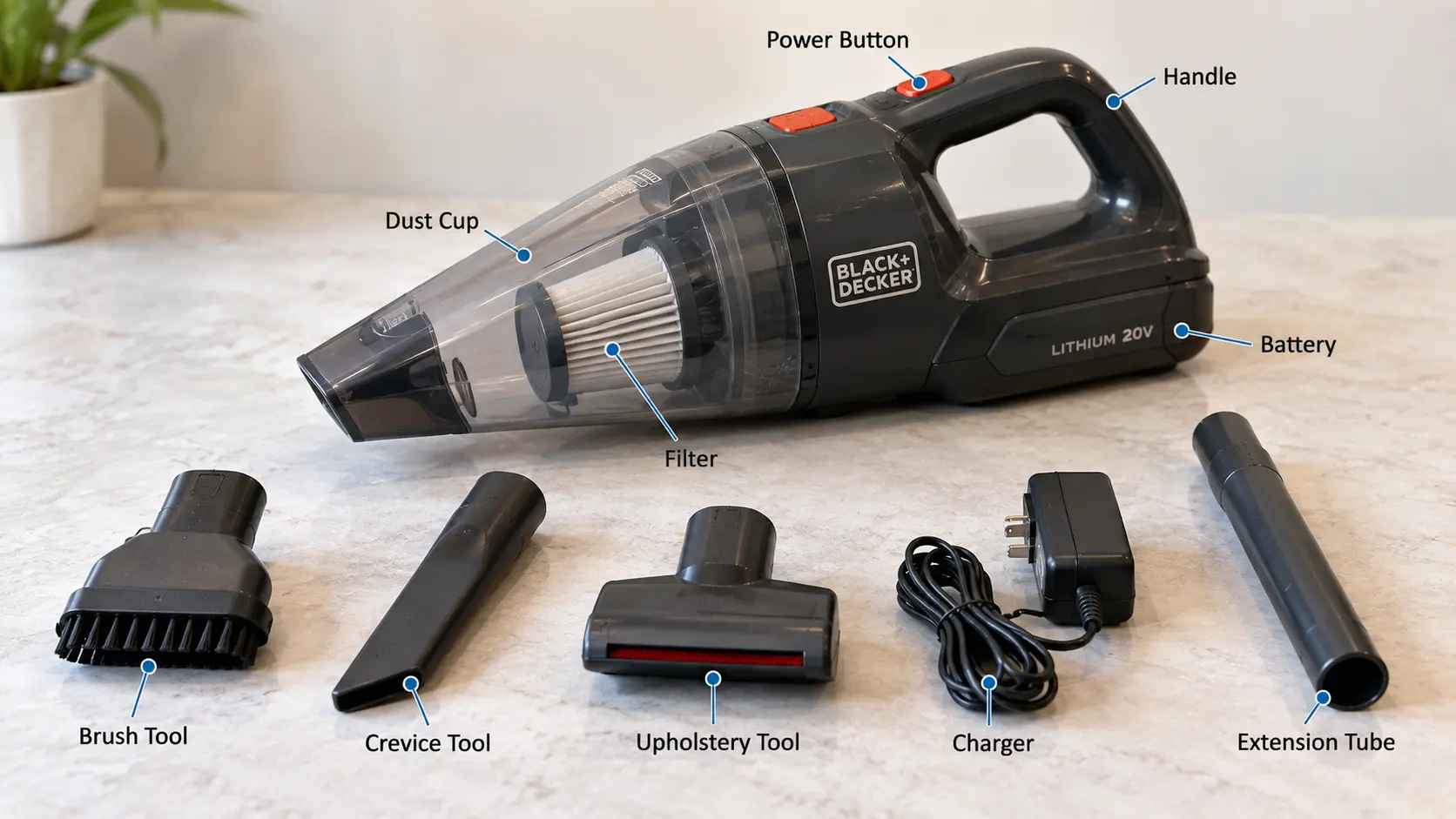
Handheld vacuum cleaners are best for small messes like crumbs, car seats, and sofa corners. They weigh only 1 to 3 pounds, and they run 10 to 30 minutes on a charge. These are quite budget-friendly too, as prices start at about $30 and go up to $150.
But remember, the suction is lower than a stick vacuum, so you should not expect deep carpet cleaning. The dustbin is tiny too, often 0.2 to 0.5 liters. Still, a handheld sits on a counter and stays ready all the time. Well, that is exactly why so many people keep one in the kitchen or the car.
Vacuum Cleaner Preferences by Floor Type
Floor type is the first thing that should guide your vacuum cleaner preference, because a vacuum that works great on tile can be poor on thick carpet. Hard floors need soft brushes and gentle contact, carpet needs a strong brush roll and strong airflow, and then mixed floors need a machine that switches between the two without any issues.
Vacuum Cleaner Preferences for Hardwood Floors
People with hardwood floors prefer vacuum cleaners with soft roller heads and a way to turn off the brush. You see, a hard bristle brush can easily scratch the finish over time, and a fast-spinning brush can push dust and crumbs around instead of picking them up. So, soft rollers pick up fine dust and glide across the wood.
Headlights are also popular. They show the dust in dark corners and under furniture. Cordless sticks and robot vacuums are common picks for hardwood, since light daily cleaning keeps grit off the floor. Grit is what causes the tiny scratches you see after a few years. So a quick pass each day really protects the finish. Also, soft rubber wheels are safer than hard plastic ones. You can check those wheels before you buy, if you’re buying robot vacuums.
Vacuum Cleaner Preferences for Carpet
Most people with carpet have vacuum cleaner preferences for a strong brush roll, good suction, and height adjustment. Here, the brush roll spins and lifts dirt out of the fibers, and the suction pulls it away. Without the brush, a vacuum only cleans the top of the carpet.
But again, pile height changes everything. Low-pile carpet, under about 0.5 inch, works with almost any vacuum cleaner. High-pile and shag carpet need a higher setting or a strong upright, or the machine will stick to the floor. Uprights with 10 to 12 amps and cordless sticks with 150 air watts or more do well here. Most robot vacuums work fine on low pile, but they struggle on thick rugs, especially rugs with long fringe.
Vacuum Cleaner Preferences for Tile and Hard Floors
Tile and hard floor owners prefer vacuums that pick up fine dust, sand, and crumbs without scattering them, and many also want a mop function. Tile, vinyl, and laminate show every speck, so the floor looks dirty fast.
Also, grout lines need a bit of extra care. Dirt hides in the small gaps, and a soft brush with good suction pulls it out. Robot vacuums with mop pads are really popular here, because they vacuum and wipe in one pass. Wet and dry vacuums also work well on sealed tile and vinyl.
Plus, I would suggest watching the water on laminate. Too much water can swell the edges, so pick a mop system that lets you control how much water comes out.
Vacuum Cleaner Preferences for Mixed-Floor Homes
Most homes have mixed floors, so the most popular pick is a vacuum that works well on both carpet and hard floors. You do not want to change tools every time you cross a rug. A stick vacuum with a switchable brush or a robot vacuum with carpet detection does the job nicely.
A robot with carpet detection raises its suction and lifts the mop pads when it reaches a rug. Some sticks change their power level on their own too. A good rule is to look at the floor you clean most, and buy for that floor first. Then check how the vacuum handles the other floor. It does not need to be perfect there, just good enough.
Vacuum Cleaner Preferences for Pet Owners
Pet owners generally prefer vacuum cleaners with tangle-free brushes, strong suction, a sealed filter, and even a bin that is easy to empty. You see, pet hair generally wraps around normal brushes fast, and it takes time to cut out. Also, about two in three US homes have a pet, so this is a really big group of buyers.
Hair is only part of the problem. Dander, litter, and dirt from paws also end up on the floor. So the filter matters a lot. A HEPA filter catches 99.97% of particles at 0.3 microns, and that covers much of the dander floating in the air. So, you need to look for a brush with rubber fins or a comb that cuts hair as it spins. Some models have a bin that empties with one click, so you never touch the hair. A small motorized pet tool is handy for the couch and the pet bed.
Next, suction power counts as well. A dog that sheds a lot needs at least 150 air watts in a stick vacuum, or around 8,000 Pa in a robot vacuum. Cats with long hair are a bit easier, but they still leave hair everywhere.
Generally, robot vacuum cleaners work great in pet homes because they run daily and stop hair from building up. You just need to check the brush once a week.
Corded vs Cordless Vacuum Cleaner Preferences
Corded vacuums draw continuous power straight from a wall outlet. This design allows for larger motors that generate around 150 to 200 Air Watts of steady suction power. Because they do not rely on a battery, you can clean large spaces or thick carpets without stopping to recharge.
These units also feature larger dustbins, which means you empty them less often during heavy cleaning sessions. However, the power cord limits your reach, and the heavier frame makes carrying the unit up and down stairs more difficult.
Cordless vacuums mainly work on rechargeable lithium-ion batteries. So, they usually offer 20 to 60 minutes of run time per charge. They generally deliver between 70 and 150 Air Watts of suction power.
Now, the biggest advantage of a cordless model is complete freedom of movement. They are light, easy to lift, and ideal for quick cleanups on stairs, hard floors, and inside cars. But again, on the downside, the battery drains quickly on high power settings, and small dustbins require frequent emptying. Furthermore, replacement batteries add to the long-term owner cost as well.
| Feature | Corded Vacuum Cleaners | Cordless Vacuum Cleaners |
| Power Source | Mains wall outlet | Rechargeable battery |
| Run Time | Unlimited continuous cleaning | 20 to 60 minutes per charge |
| Suction Strength | Strong and continuous (150-200 AW) | Moderate to high (70-150 AW) |
| Main Advantage | Deep carpet cleaning and large homes | Lightweight portability and quick setups |
| Dust Capacity | Large dustbins or dust bags | Small compact dustbins |
| Best Uses | Whole-house cleaning and heavy pet hair | Spot cleaning, stairs, cars, and hard floors |
Bagged vs Bagless Vacuum Cleaner Preferences
Bagged vacuums drop all the dirt right into a disposable paper or cloth bag. The best thing here is the bag itself works as a filter, so when it gets full, you just need to pull it out, throw it in the trash, and put a new one in. Most of these bags seal themselves shut, so you never have to breathe in dust, pollen, or pet dander. But the only real downside is you have to keep buying new bags every few months.
Bagless vacuums use a clear plastic dustbin instead. You do not need to spend extra money on bags, which obviously saves cash over time. Plus, since the bin is clear, it is super easy to see when it needs emptying, or if you accidentally sucked up something small like an earring.
Now, here, the main headache is emptying the bin. When you hit the button over the trash can, a cloud of dust almost always flies up into your face. You also have to wash the inner filters regularly to keep the suction from dropping
Bagless vacuums sell more in the US (about 80% of overall), but bagged vacuums are the better pick for people with allergies and people who hate touching dust.
| Feature | Bagged Vacuums | Bagless Vacuums |
| Dirt Storage | Disposable paper or cloth bag | Clear plastic bin |
| Dust Exposure | Very low; dust stays sealed in the bag | High; dumping the bin creates dust clouds |
| Extra Costs | Need to buy new bags over time | Zero extra cost for bags |
| Filter Care | Easy; just throw out the old bag | Harder; requires frequent washing of filters |
| Suction Loss | Rare, until the bag is totally full | Happens fast if filters get clogged with dirt |
| Best Choice For | Allergy sufferers and big homes | Budget conscious users and smaller messes |
Robot Vacuum vs Traditional Vacuum: Which Do People Prefer?
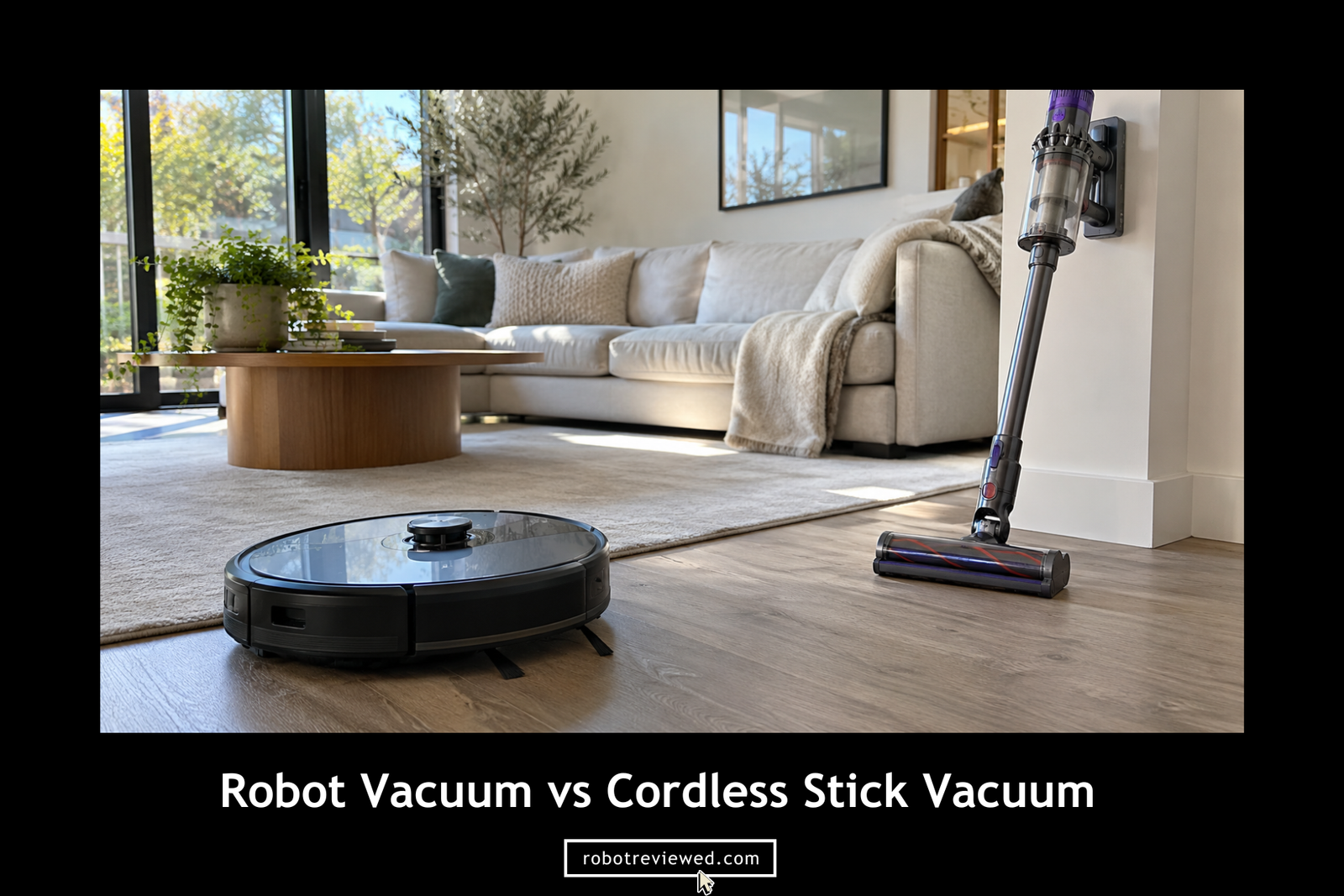
People prefer robot vacuums for daily upkeep and traditional vacuums for deep cleaning, so many homes end up with both. A robot cleans the floor every day with almost no effort from you. A traditional vacuum digs deeper into carpet and reaches stairs, sofas, and tight corners.
| Metric | Robot Vacuum | Traditional Vacuum |
| Average Price | $300 to $800 (Up to $1,200+) | $100 to $300 |
| User Cleaning Time | 10 to 15 minutes per week | 1 to 2 hours per week |
| Average Lifespan | 3 to 5 years | 7 to 10+ years |
| Suction Strength | 2,000 to 8,000 Pa | 15,000 to 25,000 Pa |
| Noise Level | 55 to 65 dB (Quiet) | 70 to 80 dB (Loud) |
| Onboard Bin Capacity | Small (0.3L to 0.5L) | Large (1.5L to 3.0L) |
Which Vacuum Cleaner Features Matter Most to Buyers?
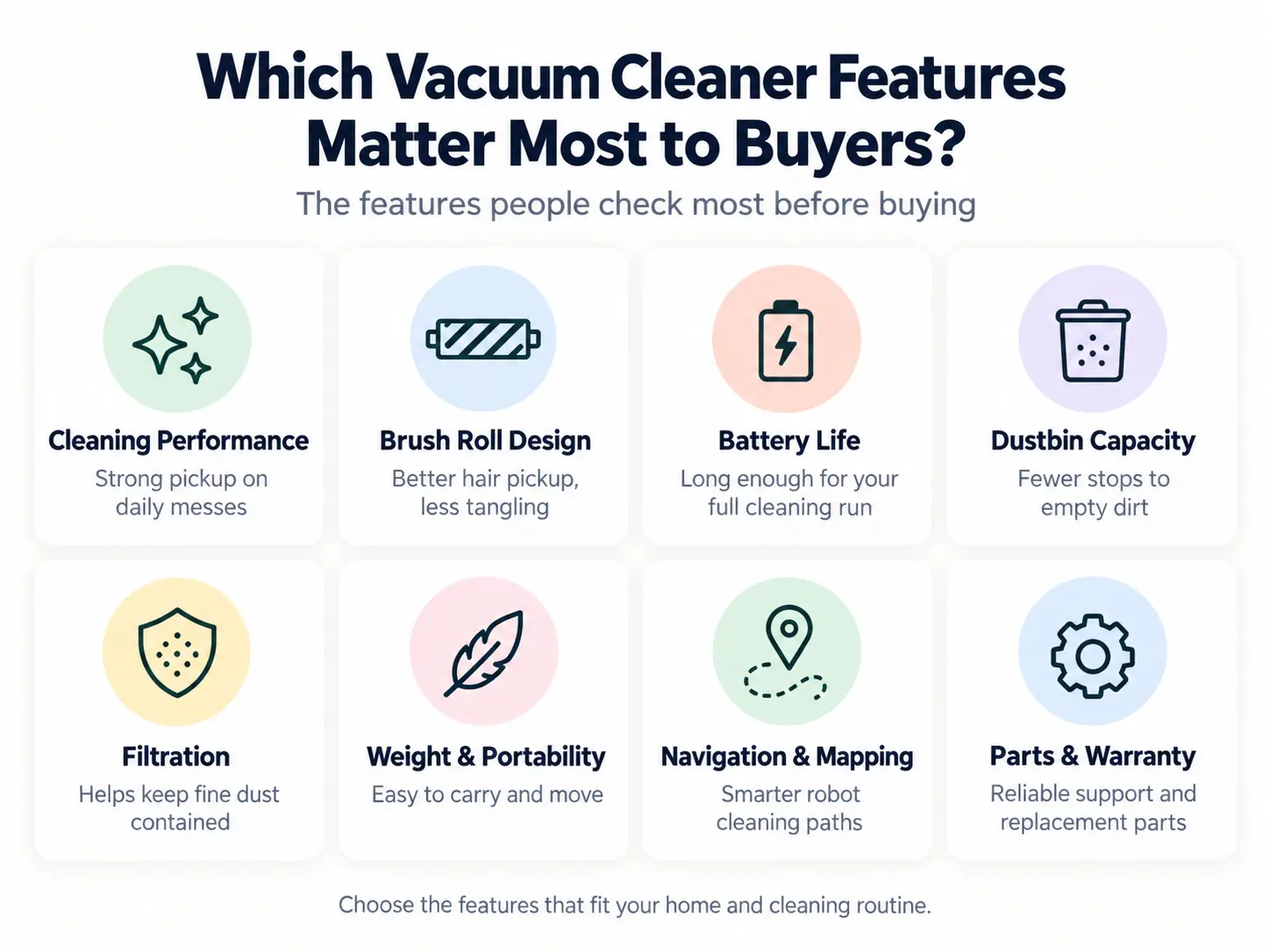
The features that matter most to buyers are cleaning power, battery life, easy emptying, low noise, and good filters. Obviously, smart features and extras help, but only after the basics are good. You can waste a lot of money on extras you never use.
Suction and Cleaning Performance
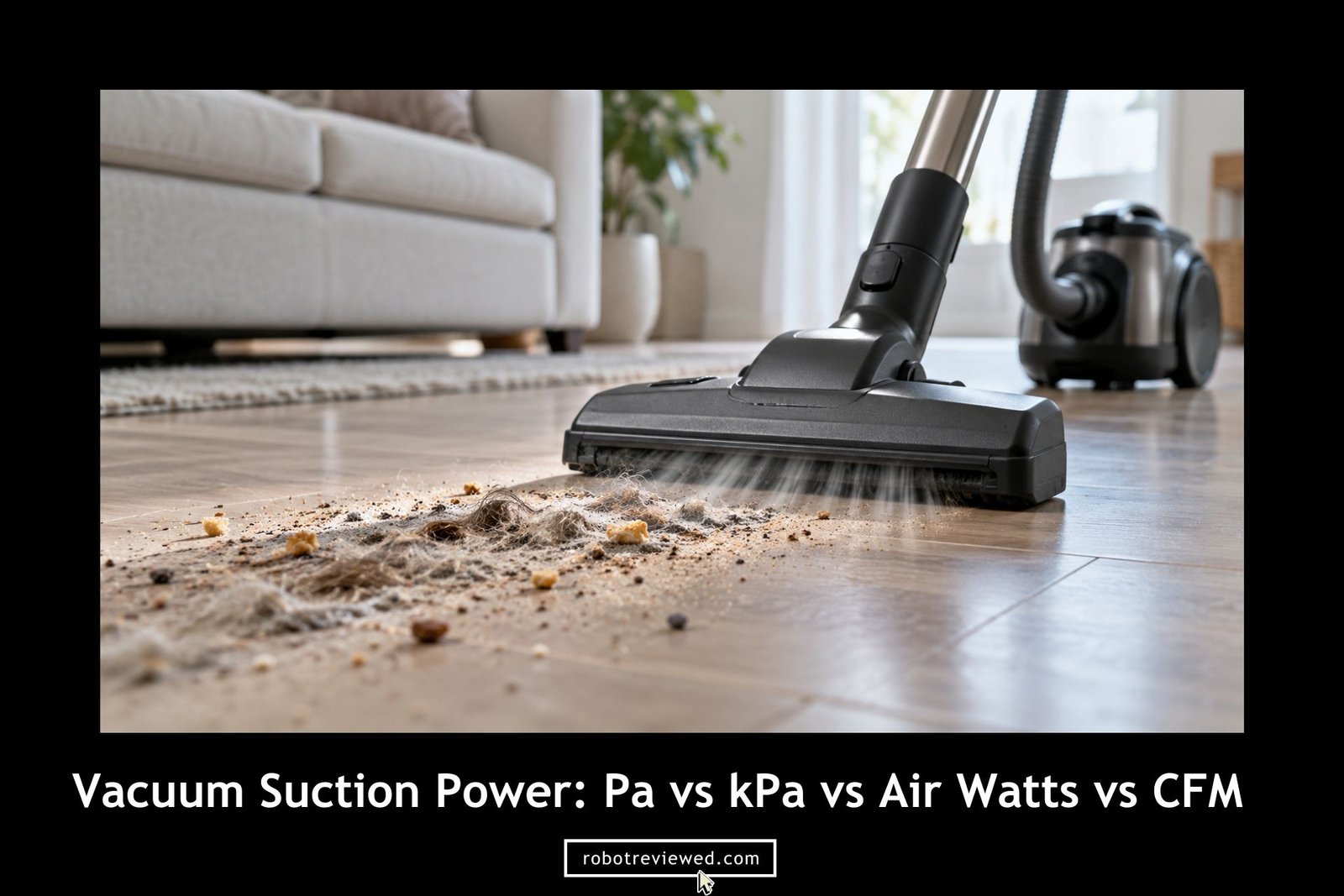
Suction is the most important feature, but the number on the box does not tell the whole story. Brands measure it in different ways. Robot vacuums use Pascals, cordless sticks use air watts, and corded models use amps or watts.
- For a robot, 5,000 to 10,000 Pa is enough for most homes.
- For a stick vacuum, 100 to 150 air watts works for hard floors, and 150 to 250 air watts is better for carpet.
- A corded upright at 10 to 12 amps is strong. Airflow, brush design, and a tight seal also change the result.
Higher suction also allows the machine to pull debris out of deep tile grout lines and hardwood gaps without needing multiple slow passes over the exact same spot.
Brush Roll Design
The brush roll makes direct physical contact with your floors to agitate trapped debris before the airflow sucks it up. Traditional bristle brushes work great on carpets, but long human hair and pet fur wrap tightly around them, requiring manual cutting.
Modern anti-tangle designs use rubber blades, counter-rotating rollers, or special internal combs to clear hair automatically into the air path. Bristle rollers work well on carpet. Soft rollers work well on hard floors. Dual rollers and anti-tangle rollers work on both.
Navigation and Mapping
Navigation decides how well a robot vacuum finds its way and how much floor it covers. So, good navigation vacuums clean in neat, straight rows. Poor navigation bumps into walls and misses spots.
Nowadays, most robots use LiDAR mapping navigation. This is a small spinning laser that draws a map of your home. A good one finishes a 1,000-square-foot floor in about 30 to 45 minutes. Also, some cheap robots use a simple sensor and random moves. They take longer and miss areas. Pick a model that saves several maps if you have more than one floor.
Obstacle Avoidance
Obstacle avoidance helps a robot vacuum steer around socks, cables, and pet waste instead of running over them. Older robots hit everything and got stuck a lot. Newer models use cameras, 3D sensors, and AI to spot small items on the floor.
Most robots climb over a threshold of about 0.6 to 0.8 inches. A few new models climb up to about 2 inches. Some flagship robots even have a small arm that moves light items out of the way. Pet waste is the worst case, so pet owners often pay $100 to $300 more for good obstacle avoidance.
Battery Life
Battery life matters because a cordless vacuum or robot should finish the planned area without becoming a charging project. A claimed 60-minute cordless runtime may apply only to low power without the main motorized head. The same vacuum can run far less on boost.
You should target at least 30 to 45 minutes for a small home and about 45 to 60 minutes for a medium home. Large homes benefit from a removable battery or a spare. Plus, robots can recharge and continue, so route speed can matter more than one battery number.
Dustbin Capacity
Dustbin capacity is how much dirt the vacuum holds before you must empty it, and a bigger bin means fewer trips to the trash. A stick vacuum holds 0.5 to 0.8 liters. A robot holds 0.3 to 0.5 liters. An upright holds 1.5 to 2.5 quarts. A bagged canister holds 2 to 4 liters.
A bin under 0.5 liters is fine for an apartment. A large home or a pet home should look for 0.7 liters or more. The dock bag on a self-emptying robot holds about 2 to 3 liters, and that lasts 30 to 60 days.
Filtration
Filtration matters because a vacuum should keep collected dust inside the machine. A True HEPA filter is commonly rated to capture at least 99.97% of particles at 0.3 microns under its test standard. Some brands say “HEPA-type,” and that is not always the same thing, so read the label with care.
The seal is just as important as the filter. Air must go through the filter, not leak out of the sides. Washable filters save money, but they need 24 hours to dry. Also, most filters need a new one every 3 to 12 months.
Noise Level
Noise level is one of the top complaints about vacuums, and it deserves a close look. Most top-rated vacuum cleaners run between 60 and 85 decibels. You know, normal talking is about 60 decibels, and heavy city traffic is about 85. Every 10-decibel jump sounds about twice as loud.
Robots often have a quiet mode around 50 to 60 decibels, and they get louder on max suction. The noise you can live with depends on your home, so check the number before you buy.
Weight and Portability
Weight decides how easy the vacuum cleaner is to use, and a heavy machine gets left in the closet. Stick vacuums weigh about 4 to 8 pounds, uprights weigh 12 to 20 pounds, handhelds weigh 1 to 3 pounds, and then robots weigh 6 to 10 pounds, but you rarely lift them.
Where the weight sits matters too. A motor in the handle feels heavier on your wrist than a motor near the floor. A model that feels light for one minute can feel heavy after ten. Try to hold it in a store before you buy.
Self-Emptying
Self-emptying means the dock sucks the dirt out of the robot and puts it in a bag or a bin. The bag holds about 2 to 3 liters, and it lasts around 30 to 60 days. A pack of bags costs about $10 to $25.
A dock adds roughly $150 to $400 to the price. It also takes floor space, and the emptying is loud for about 10 to 20 seconds. Anyway, most owners who buy a dock say they never want to go back, because they no longer empty a tiny bin every day.
App Controls
App controls let you start, stop, and schedule the vacuum from your phone. A good app shows the map, lets you pick rooms, and sends alerts when the robot is stuck or the bin is full. A bad app can ruin a good robot, so read reviews about the app and not just the machine.
You also need to check that the vacuum still works with buttons if the Wi-Fi goes down. Many robots also connect only to 2.4 GHz Wi-Fi, which trips up a lot of people during setup.
Warranty and Brand Reliability
Warranty and brand name show how much trust the maker puts in the product. Most vacuums come with 1 to 2 years of coverage. A few brands give 5 years or more on the motor, but batteries often have a shorter warranty, sometimes only one year.
You must read customer support reviews, not just product reviews. A brand with local service centers and fast replies saves you a lot of time. A cheap brand with no support can cost you more in the end.
Vacuum Cleaner Preferences for Allergy and Dust Control
Allergy and dust-control buyers prefer a sealed vacuum, high-grade filtration, and low-contact dirt disposal. People with allergies prefer bagged or fully sealed vacuums with a true HEPA filter. Indoor air can hold two to five times more pollutants than outdoor air, and a weak vacuum can easily blow that dust right back into the room. So a sealed system matters a lot here as well.
First, you need to look for a HEPA filter rated at 99.97% for 0.3 microns. The whole body should be sealed, so the air cannot leak out before it reaches the filter. A bag or a one-touch bin keeps the dust inside when you empty it. But again, wear a mask while you do that job, just to be safe.
Cleaning often helps more than cleaning hard. Vacuum two times a week if you have allergies, and go slowly over carpets, since slow passes pick up more dust than fast ones. Robot vacuums help because they run daily, and the dust never gets a chance to build up. Do not forget the mattress and the couch. A small motorized tool works well on them.
Do People Prefer Vacuum and Mop Combos?
Yes, more people prefer vacuum and mop combos each year, mainly in homes with lots of hard floors. A combo saves time because you pick up dust and wipe stains in one trip. It also saves storage space, since you own one machine instead of two.
Robot vacuums with mop pads are the most common nowadays, and they cost about $500 to $1,500 with a full dock. Wet and dry sticks with a rolling brush cost about $200 to $500. Plus, some regular vacuums also have a mop attachment, and those cost less but do less.
Combos have limits. They do not scrub hard, dried-on spills as well as you can by hand. They help less in homes with mostly carpet. Too much water can also harm unsealed wood, so check your floor type first. The mop pads need washing too, unless the dock does it for you.
You will probably like a combo if you have tile, vinyl, or sealed hardwood, and you hate the mop bucket. It is not a good deal for a home with mostly carpet, right?
How Much Are People Willing to Pay for a Vacuum Cleaner?
Most people pay between $150 and $600 for a vacuum cleaner, and the sweet spot is around $300 to $600. Cheap vacuums cost under $150, and premium ones cost $800 or more.
| Buyer type | Common shopping range | What should matter most |
|---|---|---|
| Budget | Under $150 | Basic pickup, safe floorhead, parts availability |
| Value-focused | $150 to $300 | Better brush, filtration, tools, or battery |
| Mid-range | $300 to $600 | Strong all-floor use, easier maintenance, better support |
| Premium | $600 and above | Automation, top tools, refined design, or durable build |
Smart Vacuum Cleaner Preferences
- App Control: A mobile application acts as the digital hub, connecting your smartphone directly to the vacuum over Wi-Fi. It lets you start, pause, adjust suction levels, or check component wear remotely from anywhere in the world.
- Room-Specific Cleaning: This feature uses saved digital maps to divide your home into distinct labeled areas like the kitchen or bedroom. It allows you to direct the robot to clean high-traffic areas after meals without forcing it to vacuum the entire house.
- No-Go Zones: You can draw virtual boundary lines and keep-out boxes directly on the app’s floor map. It prevents the machine from getting stuck on delicate rugs, wandering near pet water bowls, or chewing up loose floor cables.
- Cleaning Schedules: You can pre-program the vacuum to clean specific rooms at exact times and on selected days of the week. It sweeps your floors automatically while you’re at work or before you wake up in the morning.
- LiDAR Mapping: Light Detection and Ranging uses top-mounted spinning lasers to rapidly scan surrounding walls and furniture. It builds precise 2D or 3D floor maps in seconds, helping the robot navigate in straight, efficient lines even in complete darkness.
- Camera and AI Obstacle Avoidance: Front-facing optical cameras use artificial intelligence to recognize small objects lying on the floor in real time. It actively identifies and drives around hazards like stray shoes, power cords, toys, and pet waste without crashing into them.
- Voice Assistant Support: The robot links directly with smart home devices like Amazon Alexa, Google Assistant, or Apple Siri. It gives you hands-free control, so you can initiate a quick vacuuming run using simple verbal commands.
- Cleaning History: The app keeps a detailed log of every past cleaning session, complete with coverage maps, total runtime, and square footage. It lets you verify which areas were cleaned, track battery performance, and spot stuck incidents while you were away.
- Automatic Dock Features: Multifunctional dock stations use high-powered suction to pull dirt out of the robot’s dustbin and into a large sealed bag. Advanced docks also automatically wash dirty mop pads, refill internal water tanks, and blow warm air to dry the pads after a run.
What Makes People Dislike a Vacuum Cleaner?
- Too Much Noise: You see, nobody likes a machine that sounds like a jet engine in their living room. High noise levels make it impossible to watch TV or talk on the phone while cleaning. Because loud vacuums can also terrify pets and wake up sleeping kids, people often avoid using them altogether.
- Heavy Weight: Carrying a bulky machine up and down the stairs quickly turns routine cleaning into a painful workout. Heavy vacuums are tough to push across deep carpets and awkward to maneuver around chair legs as well. Even simple room-to-room cleaning gets exhausting when the unit weighs over 15 pounds.
- Poor Navigation: Poor navigation makes a robot vacuum miss spots and waste time. The robot bounces around at random, skips rooms, or forgets the map after you move a chair. It also cleans the same spot two times while it skips the next one. A robot with LiDAR mapping fixes most of these problems.
- Hair Tangling Around Brushes: Hair tangling around brushes annoys almost every owner with long hair or pets. You spend 5 to 10 minutes each week cutting hair off the roller with scissors. Anti-tangle brushes help a lot.
- Small Dustbin: A small dustbin forces you to stop and empty it again and again. A stick with a 0.5-liter bin can fill up in one room of a pet home. A robot with a 0.3-liter bin fills up even faster. A bigger bin or a self-empty dock solves the problem.
- Short Battery Life: It is incredibly annoying when a cordless vacuum dies right when you are halfway through cleaning a room. Most lithium batteries only last 15 to 20 minutes on high power mode, which is not enough time to finish the job. Plus, batteries also get weaker over time, often after two or three years. Eventually, you will need a new one, so a removable battery is a smart pick.
- Expensive Replacement Parts: People hate finding out that replacement filters, fresh dust bags, or new batteries cost a small fortune. Buying a new battery pack after a couple of years can easily cost half the price of the original vacuum. Because these recurring costs add up fast, owners end up feeling ripped off.
- Frequent Maintenance: A machine that requires constant babysitting takes all the convenience away from cleaning. You constantly have to wash dirty foam filters, unclog air tubes, and wipe down dusty sensors just to keep the suction working. But again, if you skip these chores, the performance drops almost instantly.
- Poor Customer Support: Poor customer support turns a small problem into a big headache. You wait days for a reply, a part goes out of stock, or the warranty claim gets denied. Read support reviews before you buy. Buy from a store with an easy return policy, and a 30-day return window is pretty normal.
How to Choose a Reliable Vacuum Cleaner Based on Your Preferences
The best way to choose a reliable vacuum is to match the type, power, and features to your floors, your home size, and your budget. Follow these seven steps, and you will avoid most buying mistakes.
- Check your floors. Look at uprights or strong sticks with 150 air watts or more if your home has mostly carpet. Look at soft roller heads, canisters, or robots with mops if your home has mostly hard floors.
- Count your square feet. A home under 1,000 square feet needs about 30 minutes of runtime. A home over 2,500 square feet needs a bigger bin and a second battery or a second vacuum.
- Set your budget. Keep about $50 a year aside for filters, pads, and bags.
- Pick your type. Robots are great for daily upkeep, sticks are great for speed, uprights are great for carpet, and canisters are great for hard floors and stairs.
- Check the must-haves. Look for a true HEPA filter, a bin of 0.6 liter or more, an anti-tangle brush, and noise under 70 decibels.
- Read long-term reviews. Reviews written after six months or a year tell you more than first-week reviews.
- Check the warranty, parts, and returns. You want at least one to two years of coverage, easy parts, and a fair return window.
Final Thoughts
Your vacuum cleaner preferences should come from your floors, your home, and your daily life, not from the biggest number on the box. Robots are great for daily dust, and sticks are great for quick jobs. Uprights are still the best for deep carpet cleaning, and canisters are the best for hard floors and stairs.
You should focus on the basics first. Good suction, a solid filter, a big enough bin, and a battery that lasts long enough matter more than any fancy extra. Then look at noise, weight, and the cost of parts. Those are the things you will feel every week.
Now it’s your turn. Write down your top three needs, set your budget, and compare two or three models. You will probably find the right one faster than you think.
FAQs
How much suction power is best for a vacuum cleaner?
For most homes, 100 to 150 air watts on a stick vacuum, or 5,000 to 10,000 Pa on a robot vacuum, gives enough suction. Homes with thick carpet or shedding pets do better with 150 to 250 air watts, or with a corded upright at 10 to 12 amps.
How to choose the right vacuum cleaner for your home?
You can choose the right vacuum by matching it to your floor type, home size, pets, and budget. First, you can start with your floors, since carpet and hard floors need different tools. Then think about how big your home is and how many stairs you have.
Next, add your special needs. Pets need tangle-free brushes, and allergies need a sealed HEPA system. Set your budget after that, and keep a little extra for parts. You should try the vacuum in a store if you can, and check the noise, the weight, and the return policy as well.
What is the lifespan of a vacuum cleaner
Most vacuum cleaners last about 5 to 10 years, but the type changes the number. Uprights often last 8 to 10 years. Good canisters can last 10 to 15 years. Cordless sticks last about 4 to 7 years, and the battery usually wears out in 2 to 5 years. Robot vacuums last about 3 to 6 years, and their batteries often need a change after 2 to 4 years.
Which vacuum brand is better?
Dyson is known for premium cordless sticks with strong suction and high prices. Shark is popular for value-priced uprights and pet-friendly sticks. Miele has a long record with canisters that last for many years.
Bissell and Hoover offer affordable uprights, and Bissell also makes well-known wet and dry models. For robot vacuums, Roborock, Dreame, and Eufy are strong picks with good mapping and dock options