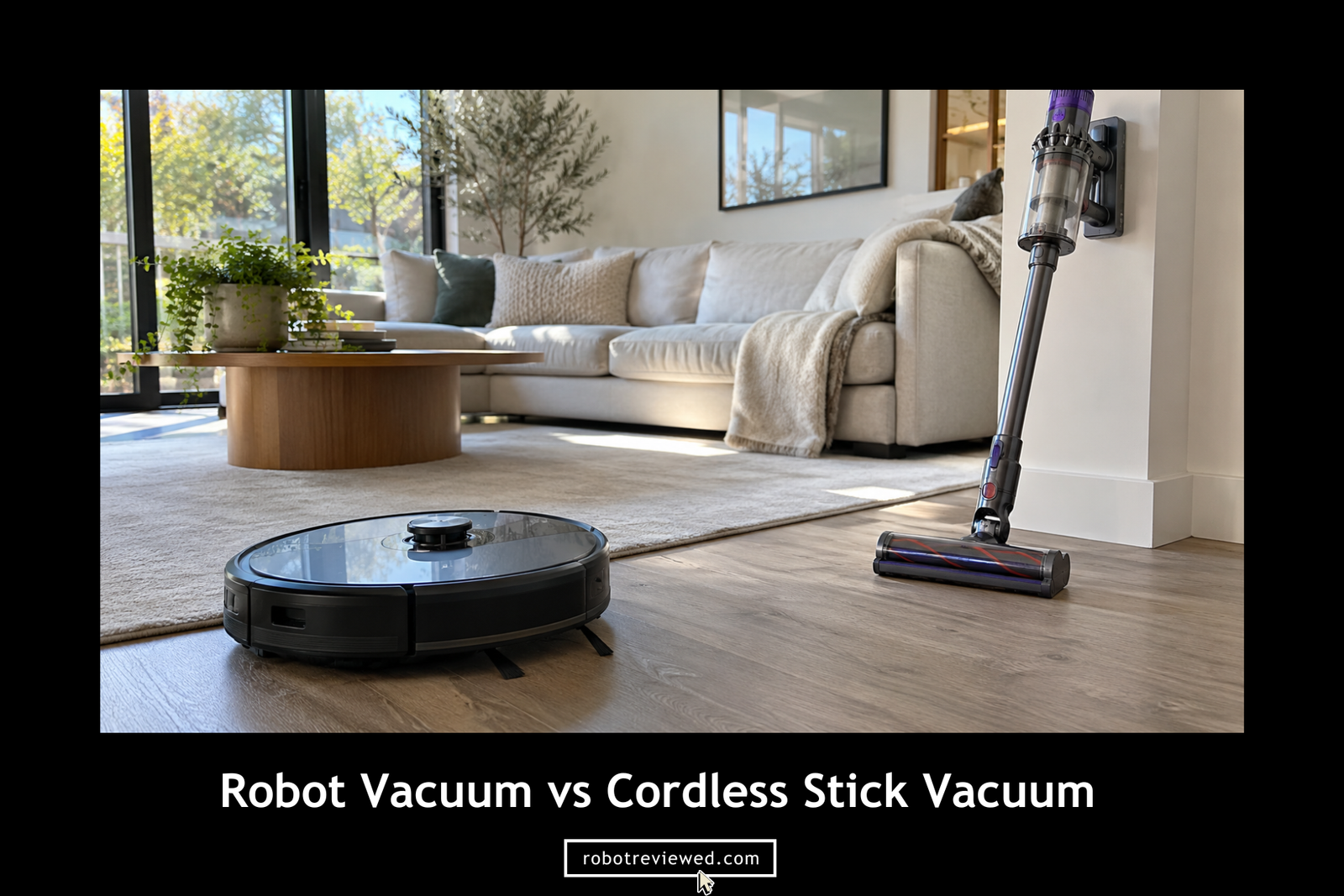
A robot vacuum cleaner handles everyday floor cleaning on its own, while a cordless vacuum still needs your hands. The cordless machine cleans deeper, faster, and in more places around the house.
Now, this guide focuses mainly on the buying decision between these two vacuum types. You will see what each cleaning machine can do, what it cannot do, and which jobs belong where. If you already want ranked model picks, use the best robot vacuums guide. You can also use the best cordless vacuums roundup for stick-vacuum rankings.
TABLE OF CONTENTS Quickly jump to a section
- Robot Vacuum vs Cordless Vacuum: Quick Comparison
- Robot Vacuum vs Cordless Vacuum for Different Floor Types
- Which Is Better for Pet Hair?
- Which Is Better for Everyday Messes?
- Where a Robot Vacuum Cannot Replace a Cordless Vacuum, or Vice Versa
- Robot vs Cordless Vacuum: Battery Life and Cleaning Coverage
- Which Requires More Maintenance?
- Cost: Is a Robot or Cordless Stick Vacuum Better Value?
- Robotic Vacuum Cleaner or Cordless Vacuum? Quick Picks Checklist
- Robot vs Cordless Vacuum: Final Comparison
- FAQs
Robot Vacuum vs Cordless Vacuum: Quick Comparison
Okay, before you read the details, this quick table shows how the two types compare on the things buyers ask about most. Treat it as a starting point, because each row gets a fuller explanation further down…
| Factor | Robotic Vacuum | Cordless Vacuum |
|---|---|---|
| Cleaning style | Automatic | Manual |
| Deep cleaning | Moderate | Better |
| Daily maintenance | Excellent | Good |
| Stairs | No | Yes |
| Furniture and sofas | No | Yes |
| Under furniture | Excellent | Depends on design |
| Pet hair | Great for daily pickup | Better for deep cleaning |
| Carpet | Good on suitable carpets | Usually better |
| Hard floors | Excellent | Excellent |
| Mopping | Available on many models | Rare |
| Effort required | Very low | Moderate |
| Price | Usually higher for advanced models | Wider price range |
Now, one thing to keep in mind is that these ratings describe the typical machine in each group. A strong robot can beat a weak cordless model on carpet, and a cheap budget robot vacuum can lose to a decent cordless vacuum on almost everything.
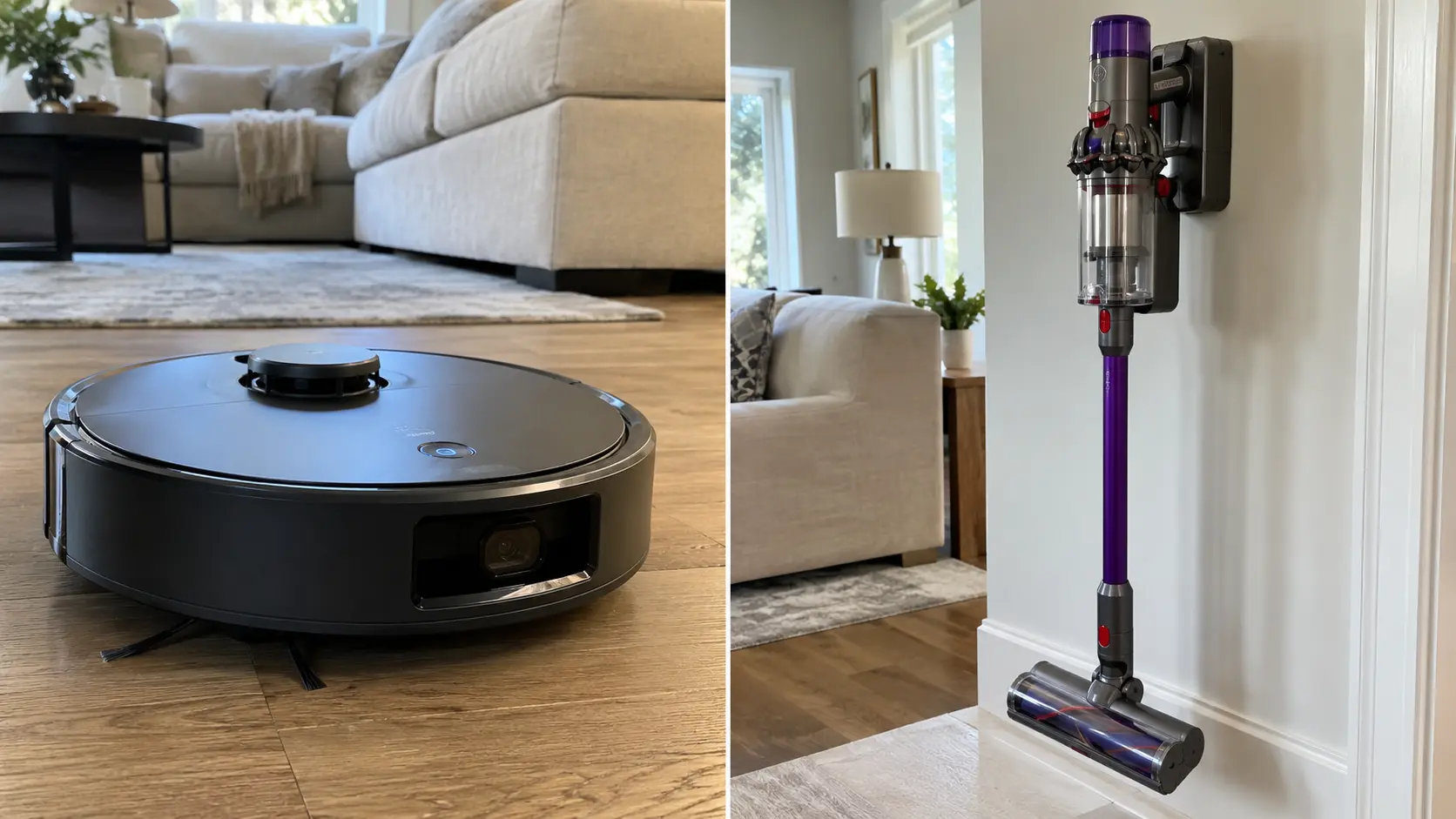
What Is the Real Difference Between a Robot and Cordless Vacuum?
A cordless vacuum makes manual cleaning easier, while a robot vacuum takes much of the manual cleaning off your plate. Now, with a cordless vacuum, you still do the work yourself. You pick it up, walk through the room, and put it back on the wall mount when you finish. The machine only removes the cord and the heavy body that older upright vacuum models had.
A robot works differently, because you press a button or set a schedule and then walk away. Well, that gap shapes everything else in this comparison. It affects how often your floors get cleaned, how deep the cleaning goes, and how much of your week it takes.
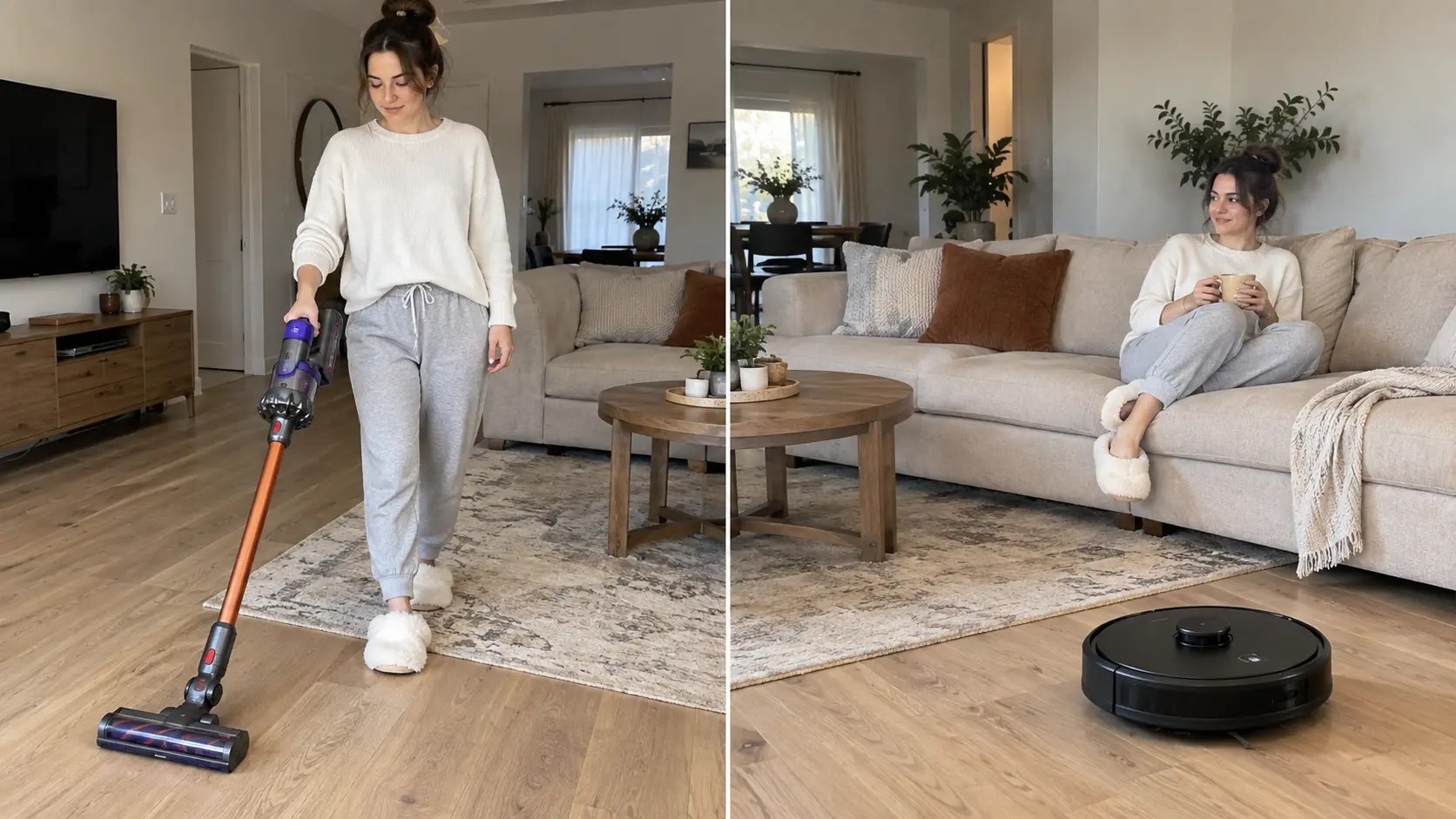
Here’s where a lot of buyers get confused when they compare the two types. Cleaning depth and cleaning frequency are separate things, and each machine wins one of them.
A cordless vacuum usually pulls more dirt out of a carpet in one pass, since you control the speed and can go over a stubborn spot again. A robot picks up less on any single run, but it can run every day while you’re at work. Light dirt that gets picked up daily never has the chance to grind into the floor. That’s why a modest robotic vacuum that runs often can leave a house looking cleaner than a strong cordless vacuum that only comes out once a week.
Next, battery numbers also mean different things on each type, so you shouldn’t compare the listed runtimes directly. A robot’s runtime tells you how long it can work without you, and many models return to the dock, recharge, and finish the job on their own.
A cordless vacuum’s runtime tells you how long you can keep cleaning before you have to stop. The long number on the box usually applies to the lowest power setting, and boost mode can drain the pack in roughly 10 to 15 minutes. Your home’s layout matters more than the raw number, since a small apartment needs far less battery than a large house with carpet in every room.
Robot Vacuum vs Cordless Vacuum for Different Floor Types
Hard Floors
On wood, tile, vinyl, and laminate, both types do a very good job. Dust, crumbs, and pet hair sit on top of a hard surface, so even a basic machine can pick up most of it.
But, I would say: a robot has the edge here, mostly because of how often it runs. It slides under beds, couches, and cabinets where dust bunnies gather, while a cordless vacuum with a bulky head can’t always fit into those gaps unless it has a wand that lies flat. A cordless vacuum does better with larger or sudden messes on hard floors. Spilled cereal, rice, and tracked-in gravel are quick work with a stick vacuum, whereas some robots will push the bigger pieces around before they suck them up.
Mopping is another point in the robot’s favor. Many robot models now vacuum and mop in one trip, but only a small number of cordless vacuums can wash floors at all. But also, you need to keep in mind that robot mops are good at light, regular wiping, not at scrubbing off dried-on spills.
Edges and corners are a weak spot for robots, as round models can’t reach all the way into a square corner, though a spinning side brush helps, and some newer models have a flat front edge that gets closer. But still, cordless wins here.
Carpet and Rugs
- A cordless vacuum with a motorized brush head usually pulls more embedded dirt out of the carpet fibers, and you can even make extra passes whenever a spot needs it.
- Robots have improved a lot, and many can now sense carpet and raise their suction on their own. Even so, most of them still pick up less from thick carpet than a good stick vacuum does in a single pass. You can also check out my guide on the best robot vacuums for carpet.
Actually, low-pile carpet and flat rugs are usually fine for a robot, especially if it runs daily. But again, thick shag rugs, long fringe, and tassels are a different story, since they can tangle in the brush or stop the robot partway through a job.
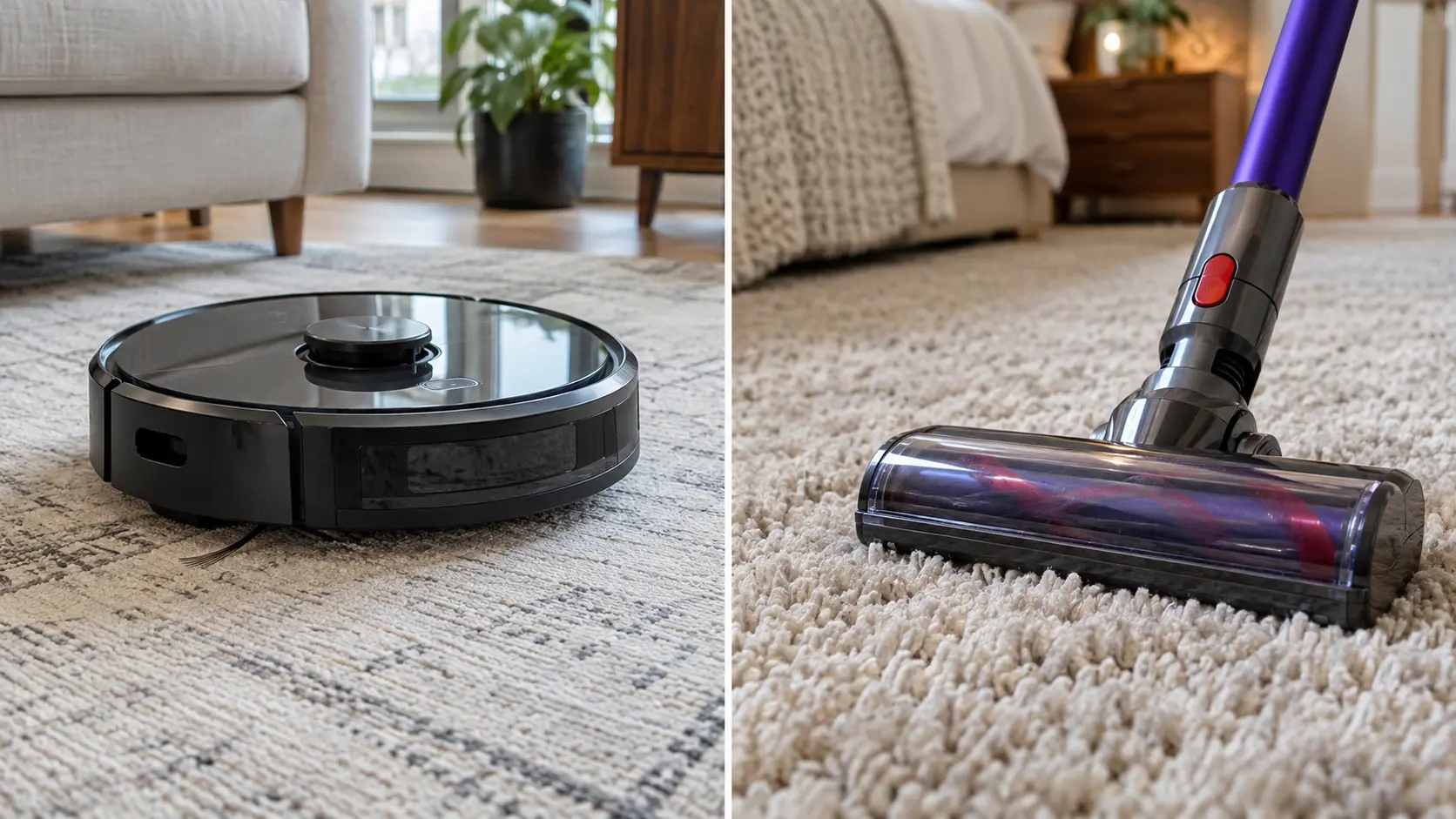
Quick Tip: Dark or black rugs can also cause trouble for some robotic vacuum cleaner models. The downward-facing sensors that keep a robot from falling down stairs may mistake a dark rug for a drop, so check the manual or user reviews before you buy if you own one.
Winner: If most of your home is carpeted, a cordless vacuum should probably be your main machine. A robot can still help between deep cleanings, but you shouldn’t expect it to replace the vacuum you push yourself.
Mixed Flooring
Most homes have some mix of hard floors and carpet, so this is the situation that applies to many vacuum cleaner buyers. Usually, the better setup depends on which surface covers more of your space.
- If you have mostly hard floors with a few area rugs, a robot vacuum cleaner is likely the better single choice. The rugs are small enough that regular passes keep them in decent shape.
- If your home is about half carpet and half hard floor, things get less clear. A robot that moves between surfaces on its own is convenient, but you’ll probably still want a cordless vacuum for the carpeted rooms. Yes, a robot vacuum with floor-type detection can raise suction on carpet and ease off on hard floors. But still, it can’t beat a stick cordless on carpets.
Which Is Better for Pet Hair?
Well, pet hair is probably the most common reason people ask this question, and the answer depends on what kind of hair problem you have.
- Daily shedding on hard floors: A robot wins here because it runs often and picks up loose fur before it spreads or turns into tumbleweeds.
- Hair embedded in carpet: A cordless vacuum is better, since the stronger brush head and your own control let you work the fibers more thoroughly.
- Hair on sofas and beds: Only a cordless vacuum with a small tool can clean upholstery, because a robot can’t climb onto furniture.
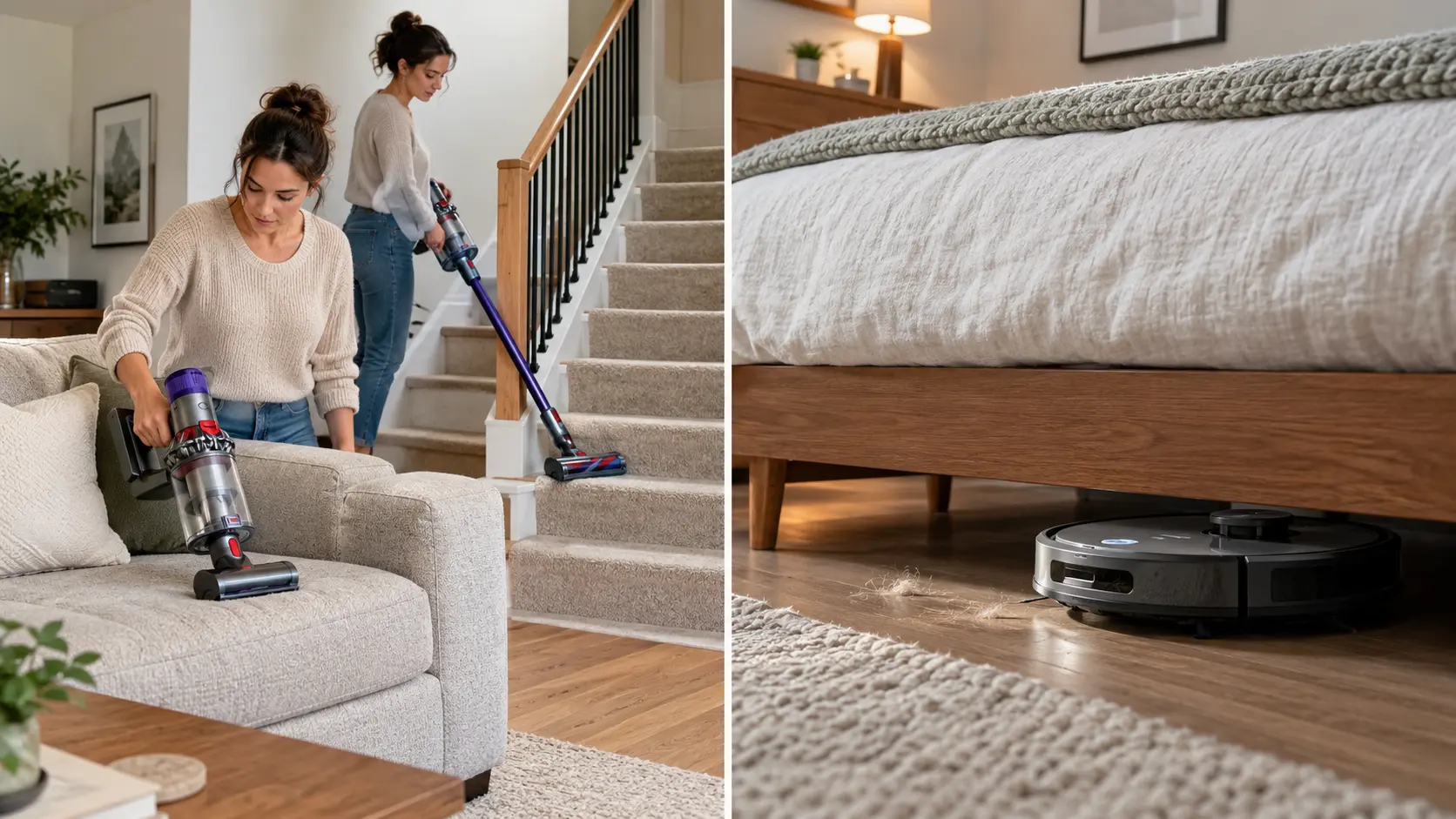
- Hair around and under furniture: A robot reaches those low spots easily, and it keeps going back there every day.
- Brush tangling: Both types get wrapped up in long fur, so look for rubber brushes or anti-tangle heads, and expect to cut hair off the roller every so often.
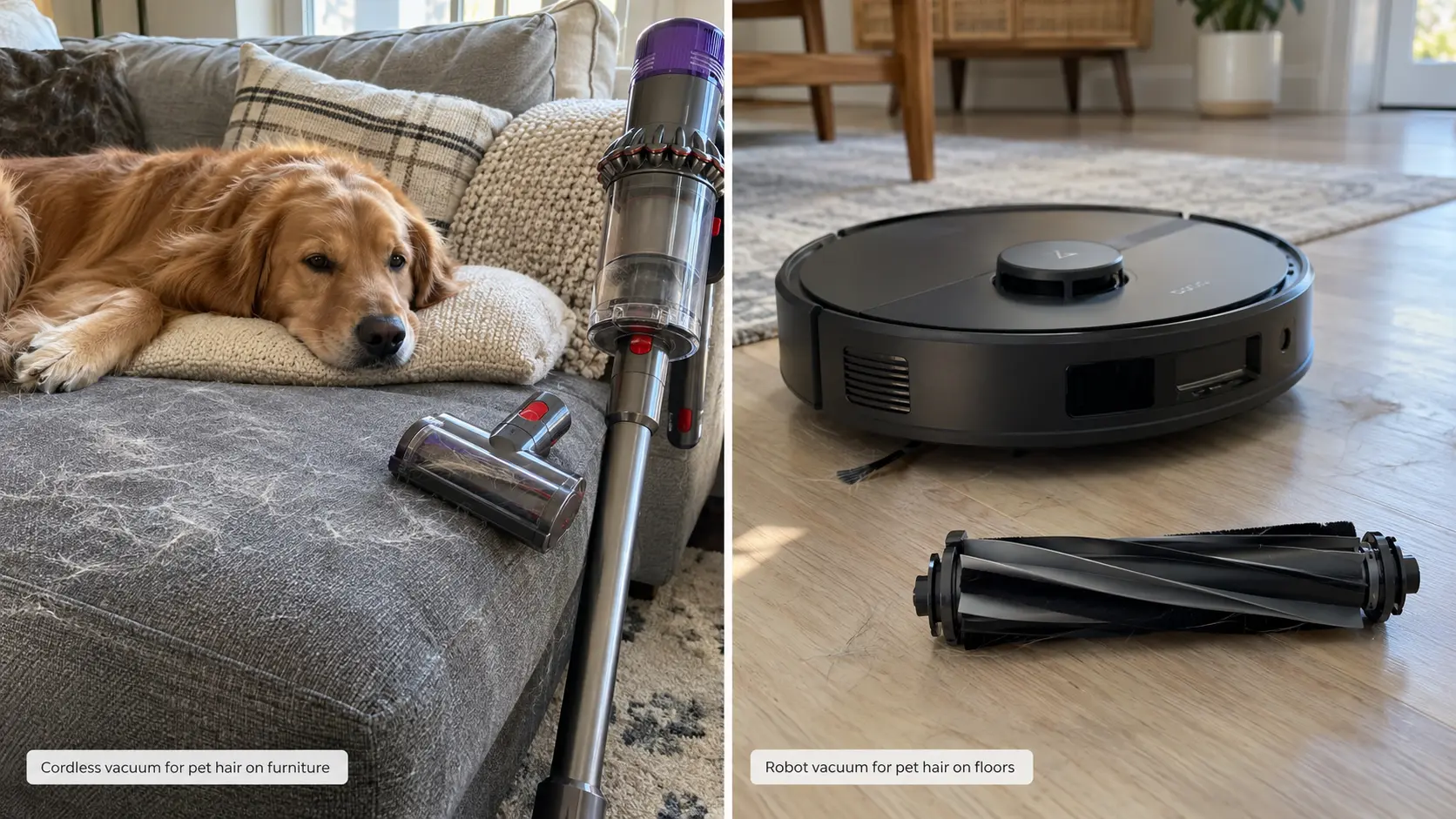
Quick Tip: If your dog or cat sheds a lot, the strongest setup is honestly both machines. The robot keeps the floors under control day to day, and the cordless handles the couch, the stairs, and the carpet.
Here’s one warning about pet accidents that many people simply skip. A robot without good obstacle detection can drive straight through pet waste and spread it across your floors, which is a nightmare to clean up. Also, if your pet has accidents now and then, you must look for a robotic model with reliable obstacle avoidance. Obviously, pick up any mess before a scheduled run starts.
Read my top picks on the best robot vacuums for pet hair…
Which Is Better for Everyday Messes?
- Crumbs after a meal: A cordless vacuum wins when you need the crumbs gone right now. You just have to grab it, clean the spot in under a minute, and you’re finished. A robot can do the same job, but you’ll have to send it to that room through the app or wait for the next scheduled run.
- Dirt near the entrance: Mud, sand, and grit collect by the door, and they scratch hard floors every time someone walks over them. A robot that runs each afternoon keeps that zone under control. A cordless vacuum works well after a muddy day, but only if you remember to use it.
- Kitchen debris: Kitchens collect dry scraps, flour, and little bits of food. Robots handle the fine dust well, while a cordless vacuum is better for a sudden spill because you can aim it right at the mess. But remember, don’t run either type over liquid unless the model is made for wet pickup.
- One-room cleanup: Okay, if you only want to clean a single room, a cordless vacuum is faster to start. Even some robots let you pick one room in the app, but that takes more steps than lifting a stick vacuum off the wall.
- Whole-home daily cleaning: This is where a robot vacuum cleaner is very hard to beat. It covers every room on a schedule without you touching it, and which is why many people find their floors stay cleaner after they switch.
Where a Robot Vacuum Cannot Replace a Cordless Vacuum, or Vice Versa
A robot is a floor machine, and floors are only part of what needs cleaning in a home.
- Stairs: A robot can’t climb them, and you shouldn’t set one loose near a staircase edge. A cordless vacuum is easy to carry up and down.
- Sofas and chairs: Crumbs and pet hair gather in the cushions, and only a handheld tool or small brush head can reach them.
- Beds and mattresses: A robot can’t get on top of a bed, so a cordless with a small attachment is the practical option.
- Cars: There’s no way to put a robot inside a car, but a cordless vacuum with a crevice tool does the job well.
- Shelves and above-floor spots: Window sills, bookshelves, and curtain edges collect dust that a floor machine will never touch.
- Tight corners: Robots are too wide for narrow gaps, such as the space behind a toilet or beside a radiator.
- Large sudden messes: A dropped bag of rice or a broken bowl of chips is faster and safer to clean with a hand-held machine.
Even a robot that’s excellent on floors leaves all of those jobs undone. So, if your home has stairs or a lot of upholstered furniture, count on needing a cordless vacuum or at least a small handheld vacuum cleaner. Now, the reverse is also true, and it deserves a fair mention. A cordless vacuum can’t clean while you’re out, and it can’t run on a schedule. It also can’t slip under a low bed by itself, recharge and keep going, or empty its own bin the way a robot with a self-emptying dock can.
Robot vs Cordless Vacuum: Battery Life and Cleaning Coverage
Do not compare advertised runtime numbers as if they mean the same kind of work. A robot that lists 180 minutes is not automatically better than a cordless vacuum that lists 60 minutes. Those numbers describe two different jobs, and mixing them leads to a bad buy.
- A robot vacuum works independently once you send it out. It can clean one floor, return to the dock, recharge, and continue the same map. A large home may take more than one session, and that is normal if resume cleaning works.
- A cordless vacuum’s runtime is the time you can actively clean before the trigger dies. Here, boost or max mode shortens that time, often by a lot, especially on carpet. Carpet uses more battery than hard floors, and you feel the cutoff in the middle of a room. That is why spare batteries matter in bigger homes more than a pretty runtime claim.
Also, a small apartment with hard floors is easy for either machine to cover. But a long ranch house with mixed carpet may need a robot with resume cleaning, or a cordless model with two batteries. Stairs add a cordless requirement that no robot runtime figure can fix. Plus, if you live on two levels, plan the coverage honestly before you spend the extra money on a dock. One robot cleans one level unless you carry it upstairs after each job. Some people keep a dock on each floor, which costs more and removes the daily lifting. That is the only way a robot covers both levels without you acting as the elevator.
Which Requires More Maintenance?
| Task | Robot Vacuum | Cordless Stick Vacuum |
|---|---|---|
| Dustbin | Empty every few runs, or let a self-emptying dock handle it | Empty after most uses, since the bin is small |
| Brushes | Clean the main brush and side brush often, as hair wraps around them | Clean the brush roll every few weeks |
| Filter | Rinse or replace on the schedule in the manual | Rinse a washable filter about once a month |
| Sensors and wheels | Wipe sensors and check wheels for trapped hair | Not needed |
| Dock, bags, and mop pads | Replace bags, wash pads, and clean the water tank | Not needed, except on wet-dry models |
| Battery | Replace after a few years | Replace after a few years, and often easier to swap |
Cost: Is a Robot or Cordless Stick Vacuum Better Value?
Cordless vacuums cover a wide range, from budget models around $100 to premium ones that cost several hundred dollars or more. Basic robots start near $150, though models with strong carpet cleaning, good obstacle avoidance, and a self-emptying dock often cost $600 to well over $1,000.
Okay, the purchase price isn’t the whole bill, so here’s what else to count:
- Replacement batteries: These can run from about fifty dollars to a couple hundred, depending on the model.
- Brushes and filters: Both types need them from time to time, and the cost is usually modest.
- Dock bags and mop supplies: Robots with docks need bags, pads, and cleaning solution, which add up slowly over the years.
- Usefulness per household: A machine that fits your home gets used, while one that doesn’t just sits in a closet.
Here’s a simple example: If you vacuum for 20 minutes, four times a week, you spend about 69 hours a year pushing a vacuum around. A robot could take most of that time off your hands, which is a real saving, but only if it cleans well enough that you don’t redo the work. A cordless vacuum gives you more uses for your money. It does floors, stairs, sofas, cars, and the occasional high shelf, so each dollar covers more jobs. A robot does one job very well, and you pay extra for the convenience.
Robotic Vacuum Cleaner or Cordless Vacuum? Quick Picks Checklist
Choose a Robot Vacuum If…
- You have mostly hard floors or low-pile carpet.
- You dislike vacuuming, or you struggle to find the time or energy for it.
- Your pets shed every day, and the hair keeps coming back.
- Your home is mostly on one level, with few or no stairs.
- You want your floors cleaned while you’re out of the house.
- Your furniture sits high enough off the floor for a robot to fit underneath.
Choose a Cordless Vacuum If…
- Your home has stairs that need regular cleaning.
- Most of your floors are carpet or thick rugs.
- You live in a smaller place where a quick manual clean is no big deal.
- You want one tool that handles floors, sofas, and your car.
- Your budget is limited and you need the most flexibility per dollar.
- You don’t mind doing the cleaning yourself, as long as it’s quick and easy.
Consider Owning Both If…
The two vacuum cleaners complement each other rather than replace each other, and the easiest way to see that is to split the jobs.
- The robot handles: Daily floor upkeep, dust under low furniture, everyday pet hair on hard floors, and cleaning that happens while you’re away.
- The cordless handles: Stairs, sofas, beds, cars, sudden spills, and the weekly deep clean on carpet.
Now, this setup makes the most sense for homes with pets, large floor areas, mixed flooring, stairs, or busy schedules. A family with kids and a dog, for example, will probably use both machines almost every day.
But again, if your budget only allows one, pick the vacuum that fixes your biggest daily problem. I would suggest: if that problem is lack of time, start with a robot, and if it’s a mix of stairs, carpet, and furniture, start with a cordless.
Robot vs Cordless Vacuum: Final Comparison
You can find your top priority in the left column and see which type fits it best…
| Your Priority | Better Fit |
|---|---|
| Hands-free daily cleaning | Robot |
| Deep carpet cleaning | Cordless |
| Stairs | Cordless |
| Pet hair every day | Robot |
| Sofa or car cleaning | Cordless |
| Cleaning while you’re away | Robot |
| One vacuum for many surfaces | Cordless |
| Minimum manual effort | Robot |
FAQs
Can a robot vacuum replace a cordless vacuum?
A robot vacuum cannot replace a cordless vacuum if you have stairs, sofas, car interiors, or sudden messes. It can replace many daily floor-vacuum sessions on one level, especially on hard floors. You will still want a manual vacuum for above-floor cleaning and for the spots a round robot cannot reach.
Does a cordless vacuum clean better than a robot vacuum?
A cordless vacuum usually cleans better on a “single deep pass” than a robot vacuum. It picks up more embedded dirt, handles edges better, and lets you aim at the mess. A robot vacuum can keep floors looking cleaner through the week because it runs more often. Depth and frequency are different kinds of better, so name the job before you pick.
Do I need both a robot vacuum and cordless vacuum?
You do not need both machines in every home, especially a small hard-floor apartment with no stairs. You should consider both if you have pets, stairs, mixed flooring, or a large layout. Well, in that setup, the robot does daily maintenance, and the cordless vacuum does targeted work.
Is a robot vacuum better than a cordless vacuum for pet hair?
A robot vacuum is better for daily pet hair on floors if you keep the schedule on. A cordless vacuum is better for pet hair on carpet fibers, furniture, and stairs. So, if hair on the sofa bothers you more than hair on the kitchen floor, start with cordless, and if the floor is the daily mess, start with a robot and add a stick vacuum later if you can.
Is a robot vacuum or cordless vacuum better for carpet?
A cordless vacuum is usually better for carpet, especially medium and thick pile. You see, a robot vacuum can maintain low-pile carpet if it runs often and has a strong brush. It is still a maintenance cleaner, not a deep-extracting carpet machine. But yes, homes that are mostly carpet should not drop the cordless option and hope the robot will catch up.
Which lasts longer, a robot vacuum or a cordless vacuum?
Neither one is a 10-year corded upright, because both depend on batteries, brushes, and filter care. A robot has more parts that can fail, including sensors and docks. A cordless vacuum has a simpler body, but the battery is a wear item you notice sooner.